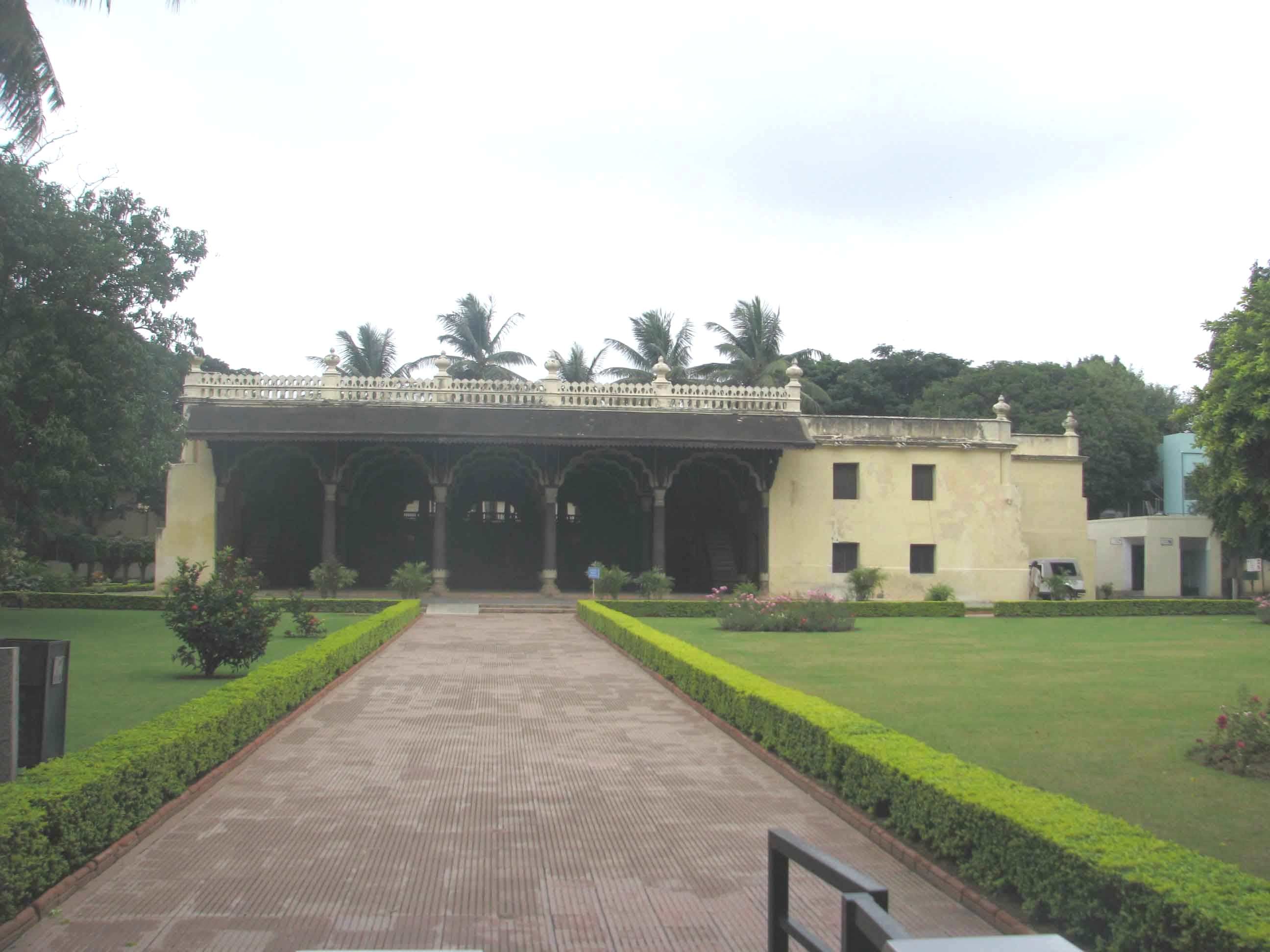
Multilingual AI audio guide exhibit on WOUDiO (PWA). WOUDiO pioneered the world’s first audio guide platform with built-in donation: listeners can support the cultural venue without leaving the listening experience. The text below is the localized description, details, and narration script for this audio guide stop.
Teak darkens as it ages. Cut fresh, it is the colour of pale honey; over two centuries it deepens toward strong tea, and the grain rises along every carved edge like the lines left on a dry riverbed. On a plateau where the dry-season sun comes in hard, a house of teak holds its coolness in a way that stone never quite manages.
Hyder Ali, the soldier who had made himself master of Mysore, understood this. In 1781 he began a palace of wood inside the old fort town of Bangalore, beside the Venkataramana temple, near the lanes of Kalasipalya. He did not see it finished. His son, Tipu Sultan, carried the work through, and the names he gave it say plainly what he wanted a building to do. An abode of happiness. Rash-e-Jannat — the envy of heaven.
The arches follow the Indo-Islamic manner, pointed and unhurried. Balconies open the upper floor to whatever breeze crosses the plateau. The pillars are worked wood, carved until the grain itself seems to curl.
The palace was completed in 1791. That same year, the army of Lord Cornwallis broke into the fort that sheltered it.
Tipu did not keep his heaven for long. After his death in 1799, new men walked in under the teak arches, and they did not come to rest. The envy of heaven became an office. The British set up their secretariat in the sultan's summer rooms, and for nearly seventy years the paperwork of a new power moved across these floors, in ink and ledgers and the scrape of chairs on wood. Only in 1868, when the rooms had grown cramped, were the files carted away to a new red building at the edge of Cubbon Park.
Today the Archaeological Survey of India keeps the house. On the ground floor, a small museum tells of Tipu's reign, and among its pieces sits a replica of Tipu's Tiger.
The teak goes on darkening, one dry season after another. A few hundred paces north, the stone of the fort Hyder Ali raised still carries the mark of that March night in 1791, and the trail bends that way next.
Site: Tipu Sultan's Summer Palace, old fort area near Kalasipalya, beside the Venkataramana temple
Built: Begun 1781 by Hyder Ali; completed 1791 under Tipu Sultan
Key facts: Largely teak, Indo-Islamic style; called "Rash-e-Jannat" (envy of heaven); British secretariat until 1868; maintained by the ASI, with a museum of Tipu's reign
Map:
Bengaluru map
Official Site:
Karnataka Tourism
Photo: युकेश at hi.wikipedia /
Wikimedia Commons (PUBLIC-DOMAIN)