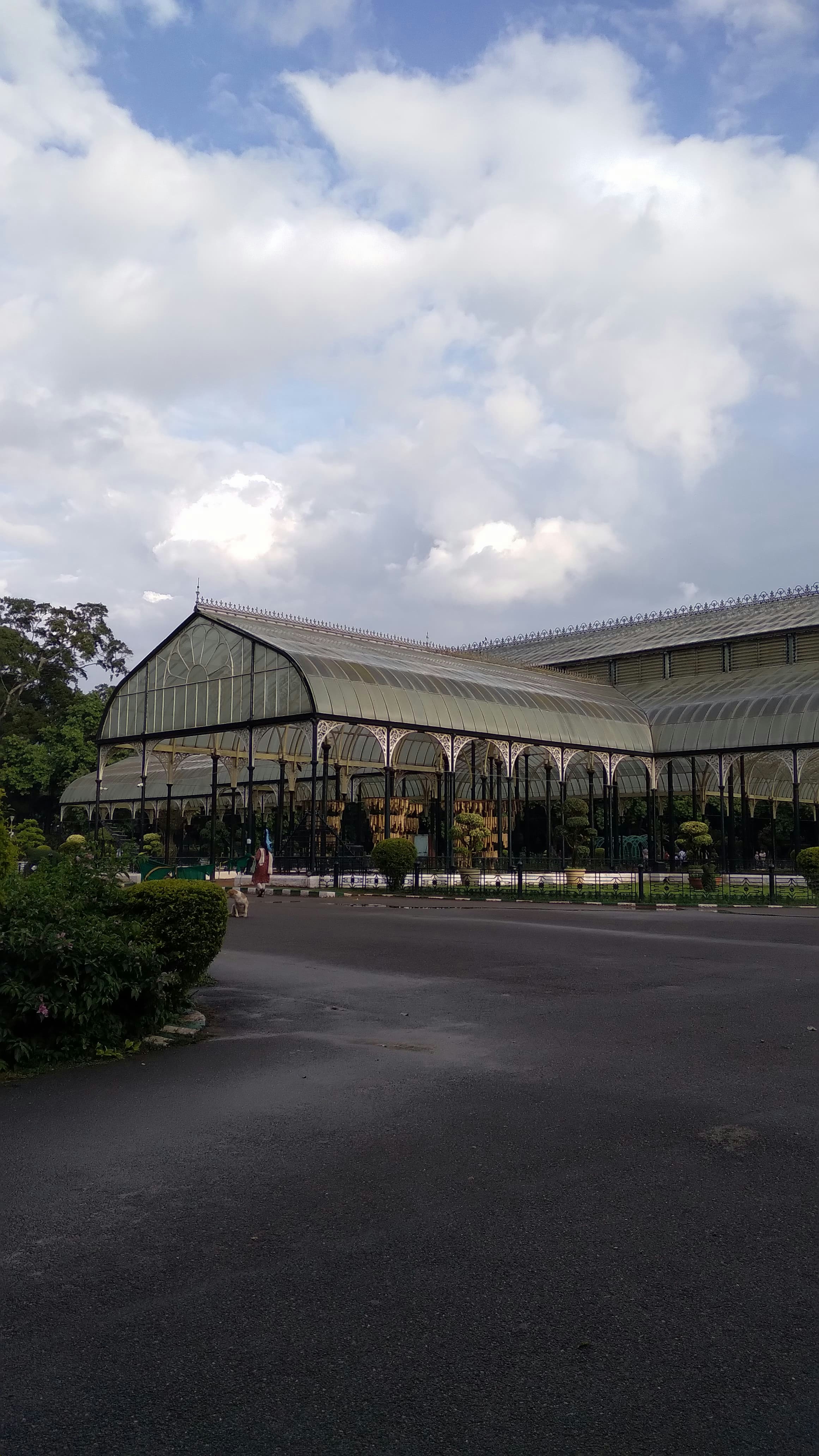
Multilingual AI audio guide exhibit on WOUDiO (PWA). WOUDiO pioneered the world’s first audio guide platform with built-in donation: listeners can support the cultural venue without leaving the listening experience. The text below is the localized description, details, and narration script for this audio guide stop.
The oldest thing in the city is older by an almost unthinkable margin. Inside Lalbagh, a broad back of bare rock rises out of the lawns. It is peninsular gneiss, and geologists put its age at around three thousand million years, one of the oldest rock formations on Earth, now a National Geological Monument. Long before any root existed to grip it, this stone lay open to the sky.
Everything else in the garden arrived from somewhere.
In 1760 Hyder Ali ordered a garden laid out below the rock, on the model of the Mughal gardens. His son, Tipu Sultan, finished it and filled it with plants brought from Persia, from Afghanistan, from France. Seeds and saplings crossed mountains and seas to put down roots on this plateau. The garden took the name Lalbagh, the red garden, usually linked to its red roses.
The first men to run it were Mohammed Ali and his son, Abdul Khader. Alongside them worked the Thigalas, a gardening community who had come up from the Tamil country to tend the royal grounds. Their hands turned this soil for generations.
Then the British arrived, and with them a new kind of traveller: the botanist. Hugh Cleghorn advised on the garden from 1855. John Cameron, trained at Kew, became superintendent. In these beds they trialled cinchona, coffee, tea, macadamia and pecan, testing on this mild high ground which of the world's plants could be made to grow in India.
In 1889 came the strangest arrival of all. Prince Albert Victor, Queen Victoria's grandson, laid the foundation stone of a glass house modelled on London's Crystal Palace. Its cast iron was made in Glasgow and shipped halfway around the world. A Scottish skeleton of iron, dressed in glass, set down on the Deccan beside a rock three billion years old!
Twice a year, in the weeks around Republic Day and Independence Day, the Glass House fills with flowers and the crowds pour in to see them. A great silk-cotton tree, said to be about two hundred and fifty years old, has watched those crowds come and go.
On the summit of the rock, one of the Kempe Gowda towers still keeps its watch over the whole garden.
The green thread does not stop at the garden wall. It runs north through the city, toward a park drawn up by a British engineer.
Site: Lalbagh Botanical Garden (240 acres)
Built: Commissioned by Hyder Ali in 1760; completed by Tipu Sultan
Key facts: Over 1,800 plant species. Glass House foundation stone laid by Prince Albert Victor on 30 November 1889, modelled on the Crystal Palace. Lalbagh Rock is peninsular gneiss about 3,000 million years old, a National Geological Monument, topped by a Kempe Gowda tower. Flower shows around Republic Day and Independence Day.
Map:
Bengaluru map
Official Site:
Karnataka Tourism
Photo: Chinmay Dhope /
Unsplash (unsplash)