Multilingual AI audio guide exhibit on WOUDiO (PWA). WOUDiO pioneered the world’s first audio guide platform with built-in donation: listeners can support the cultural venue without leaving the listening experience. The text below is the localized description, details, and narration script for this audio guide stop.
Wind through bamboo makes a dry, hollow knocking: stems tapping against stems, leaves hissing above them. In the groves of Cubbon Park, at the centre of the city, that sound runs beneath the traffic like a second, older weather.
The park began in 1870, under a British engineer, Major General Richard Sankey, Chief Engineer of the princely state of Mysore. It covered about a hundred acres then. It has grown to about three hundred.
Its first name was Meade's Park, after the acting commissioner, Sir John Meade. The name did not hold. Later the park was renamed for another man, Sir Mark Cubbon, who had governed Mysore as commissioner for more than a quarter of a century, from 1834 to 1861. By the time the first trees went into the ground, Cubbon's long tenure was already over. The park carries the name of a man whose years in charge had ended before it existed.
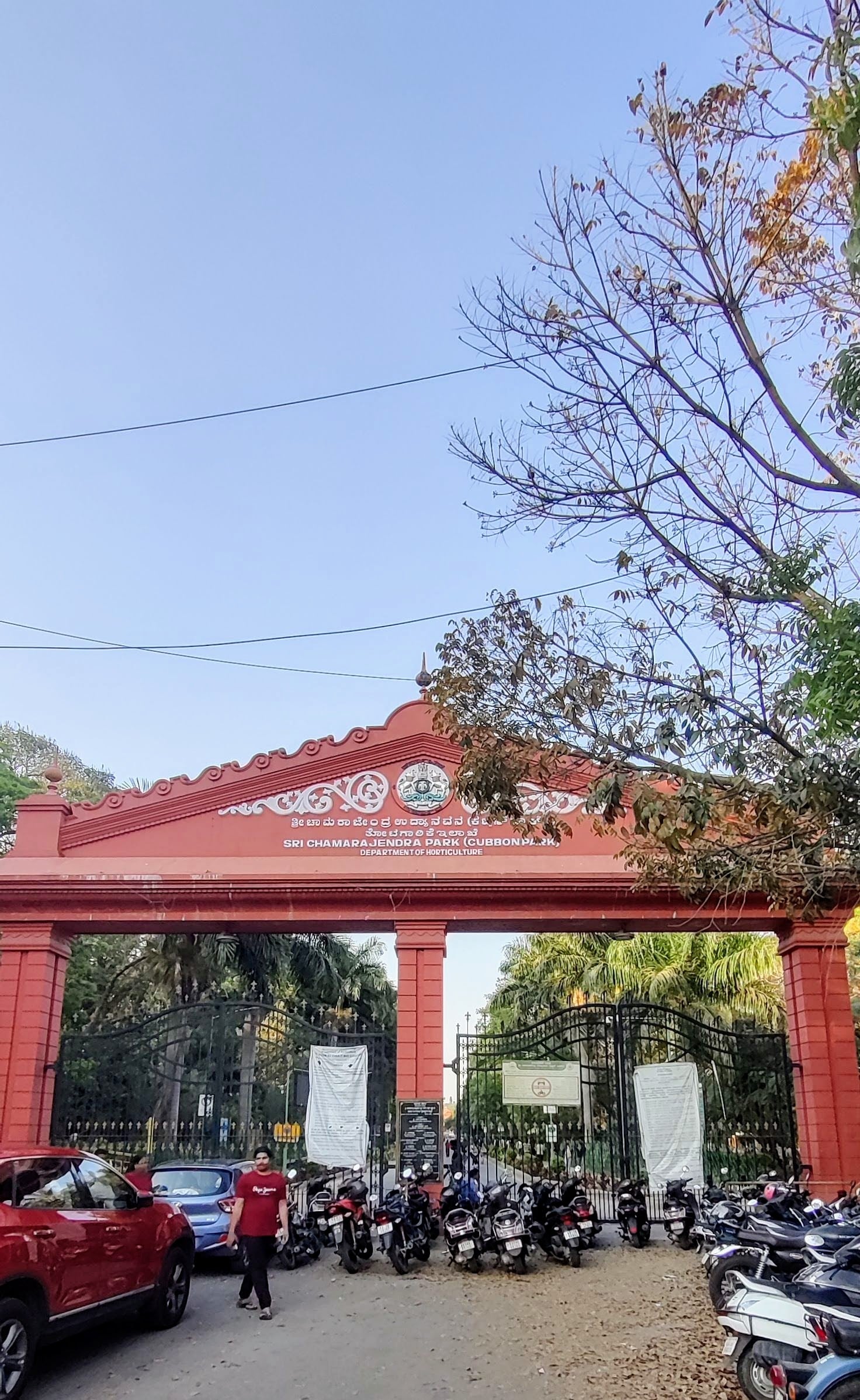
Then, in 1927, a third name. For the silver jubilee of Maharaja Krishnaraja Wadiyar the Fourth, the park officially became Sri Chamarajendra Park. That is the name on the government's papers. It is almost never the name anyone says.
The statues across the park keep a record of who came and who went. Queen Victoria. King Edward the Seventh. Mark Cubbon himself. Maharaja Chamarajendra Wadiyar. And the Dewan, Sir K. Seshadri Iyer. A British queen and an Indian minister, sharing the same lawns.
The Dewan was given more than a statue. In 1915 a hall rose in his memory, red against the green, lined with Tuscan and Corinthian columns. It is now the State Central Library. Around two hundred and sixty-five thousand books are kept inside, and readers and students cross the park from all over the city to reach them. The people who once came to Mysore to rule it left behind a place where people now come simply to read.
About six thousand plants grow across the park, from close to a hundred species, and the bamboo still knocks whenever the wind picks up.
The engineers who drew these lawns faced a harder problem just beyond them. A city with no river still had to drink. The road bends now toward the tanks and lakes that held its water.
Site: Cubbon Park (officially Sri Chamarajendra Park), about 300 acres
Built: 1870, under Major General Richard Sankey
Key facts: First called Meade's Park; renamed after Sir Mark Cubbon (commissioner 1834–1861); officially Sri Chamarajendra Park since 1927. The red State Central Library (Seshadri Iyer Memorial Hall, 1915) holds about 265,000 books.
Map:
Bengaluru map
Official Site:
Karnataka Tourism
Photo: SerChevalerie /
Wikimedia Commons.jpg) (CC0)