Multilingual AI audio guide exhibit on WOUDiO (PWA). WOUDiO pioneered the world’s first audio guide platform with built-in donation: listeners can support the cultural venue without leaving the listening experience. The text below is the localized description, details, and narration script for this audio guide stop.
Past midnight on the full moon of Chaitra, the lanes of Thigalarpet do not sleep. The air is heavy with the scent of fresh flowers, rooftops are crowded with watchers, and somewhere in the press of bodies, bare sword blades catch the light.
At the heart of this night are the Thigalas, a community of gardeners and farmers. The story most often told is that they came up from the Tamil country in the eighteenth century, when Hyder Ali and Tipu Sultan were laying out great gardens on this plateau and needed skilled hands to work them. They brought their craft with the soil, and they brought their goddess.
Their temple is the Dharmaraya Swamy Temple, one of the few dedicated to the Pandava brothers of the Mahabharata, together with Krishna and Draupadi. During the Karaga festival, Draupadi is worshipped as a form of Adishakti, the primal power. It is said that she promised to return to her people once every year, on the full moon of Chaitra.
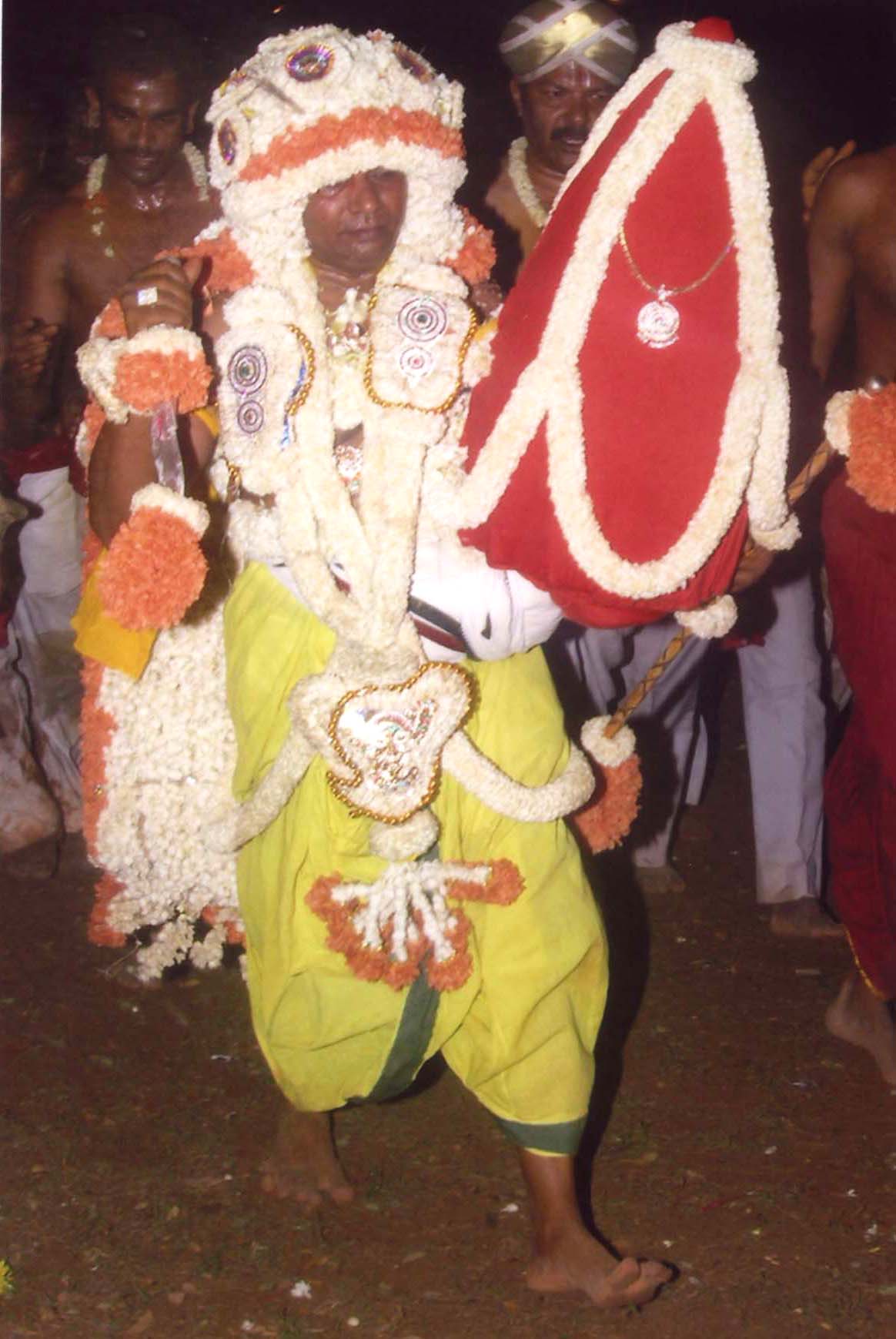
She returns on a man's head. The karaga bearer is a Thigala priest dressed as a woman, his wrists heavy with bangles. On his head rises the karaga itself, a towering form covered in flowers, and he carries it through the entire night without once steadying it with his hands. Around him move the Veerakumaras, initiated men of the community with bare swords, guarding him as Draupadi's warriors.
Winding through the old market quarters, the procession makes one particular stop: the dargah of Hazrat Tawakkal Mastan, a Sufi saint of the eighteenth century, in Cottonpet. A goddess carried by a gardener-priest pays her call at a Muslim saint's shrine, and in all the years of the festival that visit has never been broken.
How old is the custom? Some say three hundred years, some say far more, and the temple itself is claimed to be older than Kempe Gowda's town. The sources do not agree.
Before sunrise the karaga is back inside the temple. The swords are lowered, the flowers begin to wilt, and the gardeners return to the soil their families have worked for generations. When the Chaitra moon swells full again, the goddess will set out once more along the same crooked lanes.
Site: Sri Dharmaraya Swamy Temple, Thigalarpet
Festival: Bengaluru Karaga, held over several days in the month of Chaitra (March–April), with the main procession on the night of the full moon
Key facts: led by the Thigala gardening community; the karaga bearer, a priest dressed as a woman, carries the flower karaga without touching it; escorted by sword-bearing Veerakumaras; the procession visits the dargah of Hazrat Tawakkal Mastan; the festival's age is disputed
Map:
Bengaluru map
Official Site:
Karnataka Tourism
Photo: Thigala4u alias Shri from Thigalarapete, Bangalore, India /
Wikimedia Commons (CC-BY-SA-2.0)