Multilingual AI audio guide exhibit on WOUDiO (PWA). WOUDiO pioneered the world’s first audio guide platform with built-in donation: listeners can support the cultural venue without leaving the listening experience. The text below is the localized description, details, and narration script for this audio guide stop.
Earth, packed hard, rising in a long bank. Beyond it, a ditch full of standing water. The first wall of this city was not stone. It was mud.
In 1537 a chief named Kempe Gowda, lord of Yelahanka to the north, received permission from the Vijayanagara emperor to build. He was in his late twenties, a man of the Morasu Vokkaliga farming people, ruling as a vassal of the great southern empire. What he raised was a fort of earth with a moat around it, and inside it, a new town.
The plan was simple, and it has lasted. Two main streets crossed at a square called Doddapete. Around them lay market quarters, each given to a trade: cotton, grain, rice, the crafts. Kempe Gowda called this country gandu bhoomi, the land of heroes. Almost five centuries on, traders still crowd those narrow streets along the same lines.
His own road did not run straight. He fell out with the empire, lost his lands, and spent five years in prison before he was restored.
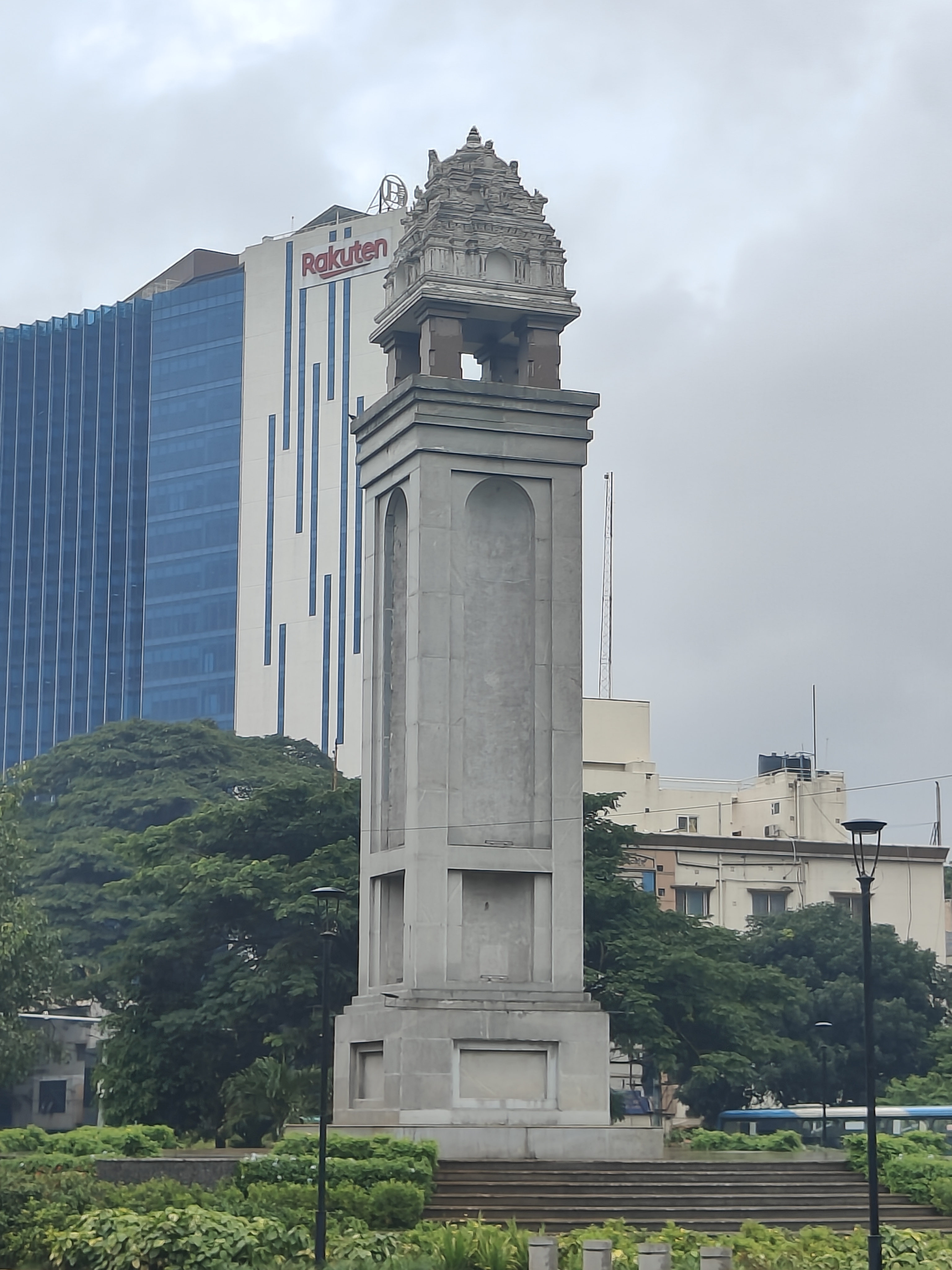
Then came the towers. Four small watchtowers on high ground at the four edges of the town: one on the great rock in the south, one by the lake at Ulsoor in the east, one to the north near what is now Mekhri Circle, and one in the west beside Kempambudhi tank. Who built them is not settled. Tradition gives them to the Kempe Gowda family, most often to his successor, Kempe Gowda the Second.
And then there is the story. People say the towers were never really defences. They were a promise, the story goes: Kempe Gowda's mark of how far his city would one day reach, and no further.
The city did not listen! It spilled past those four points long ago and kept going, tens of kilometres beyond every one of them, over ridges and valleys no founder could have mapped.
On the southern rock, the little tower still stands on bare stone, older than the garden that would later grow around it.
The founder's name travels too. It is on the city's main bus station and on its international airport, where a bronze figure of him, well over thirty metres tall, was unveiled in 2022. The four towers now sit deep inside the city they were meant to enclose. And the road runs on, down to the foot of that southern rock, where a sultan would one day begin a garden.
Site: Kempegowda Tower on Lalbagh Rock (one of four; the others stand near Ulsoor Lake, Mekhri Circle and Kempambudhi Tank)
Built: Mud fort and town founded 1537 by Kempe Gowda I; towers by the Kempe Gowda family, traditionally Kempe Gowda II
Key facts: Town laid out around two main streets crossing at Doddapete, with trade quarters (petes). The towers as the city's future limits is a popular legend.
Map:
Bengaluru map
Official Site:
Karnataka Tourism
Photo: Rohan Pinto /
Wikimedia Commons (CC-BY-SA-4.0)