Multilingual AI audio guide exhibit on WOUDiO (PWA). WOUDiO pioneered the world’s first audio guide platform with built-in donation: listeners can support the cultural venue without leaving the listening experience. The text below is the localized description, details, and narration script for this audio guide stop.
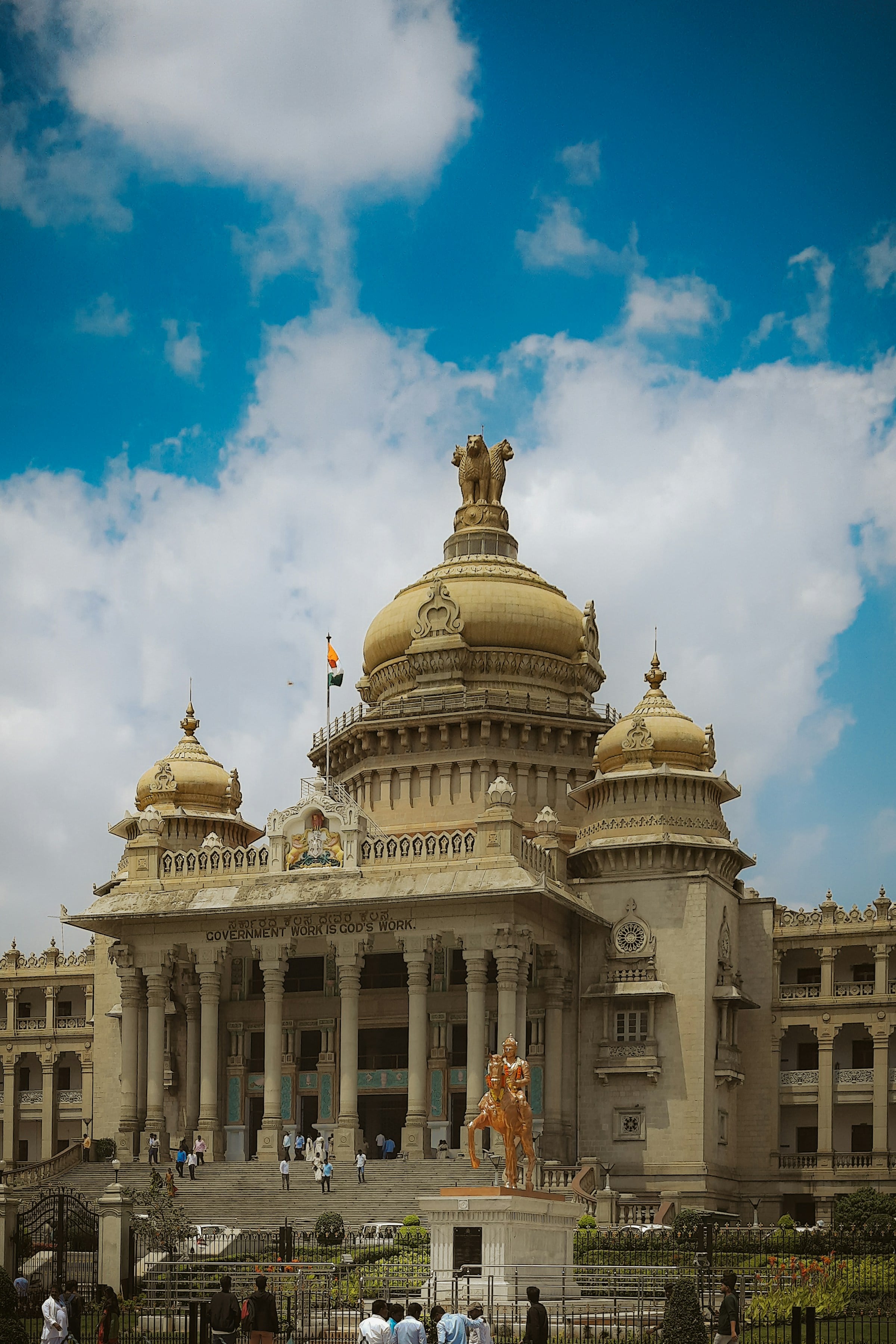
Two buildings face each other across a road at the edge of Cubbon Park. One is red ochre, lined with Ionic columns like a European courthouse. The other is a great mass of carved stone crowned with domes. Between them lies a long argument about what this city should look like.
The red building came first. In the 1860s the British administration was still working out of Tipu Sultan's old palace, in offices that had grown cramped and unsafe. Commissioner Lewin Bowring ordered new ones. Richard Sankey designed them, a contractor named Arcot Narrainswamy Mudaliar built them, and in 1868 the clerks moved in. People called it Attara Kacheri, the eighteen offices. Today it is the Karnataka High Court.
After independence came a different builder: Chief Minister Kengal Hanumanthaiah. Jawaharlal Nehru laid the foundation stone of a new legislative house in July 1951, and construction began the following year. The story goes that a visiting Soviet delegation remarked that every grand building in the city looked European. The details of that visit are uncertain, but the answer was clear. Hanumanthaiah wanted an Indian building, in a Neo-Dravidian style drawing on Chalukya, Hoysala and Vijayanagara architecture.
To raise it, more than five thousand workers came to the site, among them some fifteen hundred chisellers, masons and wood carvers. For four years the ring of chisel on stone carried across the edge of the park while the building took shape by hand.
When Vidhana Soudha was completed in 1956, a line was set over its entrance, in English and in Kannada. Government Work is God's Work. The words still greet everyone who comes to the legislature, from ministers to clerks.
The red building nearly vanished. In 1982 the government planned to demolish Attara Kacheri. Citizens took the plan to court, the Supreme Court stepped in, and by 1985 it was dropped. So both still stand: one ordered by a colonial commissioner, the other by an elected chief minister, each shaped by the hands of workers who came to this plateau to build.
Every morning, legislators file into one and lawyers into the other, and the conversation between the two buildings, about what the city owes to its past and what it owes to its people, carries on across the road.
Site: Vidhana Soudha, with Attara Kacheri (Karnataka High Court) directly opposite, at the edge of Cubbon Park
Built: Vidhana Soudha 1952–1956 (foundation stone laid by Nehru, 13 July 1951); Attara Kacheri 1864–1868
Key facts: seat of the Karnataka Legislature and Secretariat; Neo-Dravidian style promoted by Chief Minister Kengal Hanumanthaiah; more than 5,000 workers; inscription "Government Work is God's Work"; Attara Kacheri designed by Richard Sankey and saved from demolition in the 1980s
Map:
Bengaluru map
Official Site:
Karnataka Tourism
Photo: zablanca_clicks /
Unsplash (unsplash)