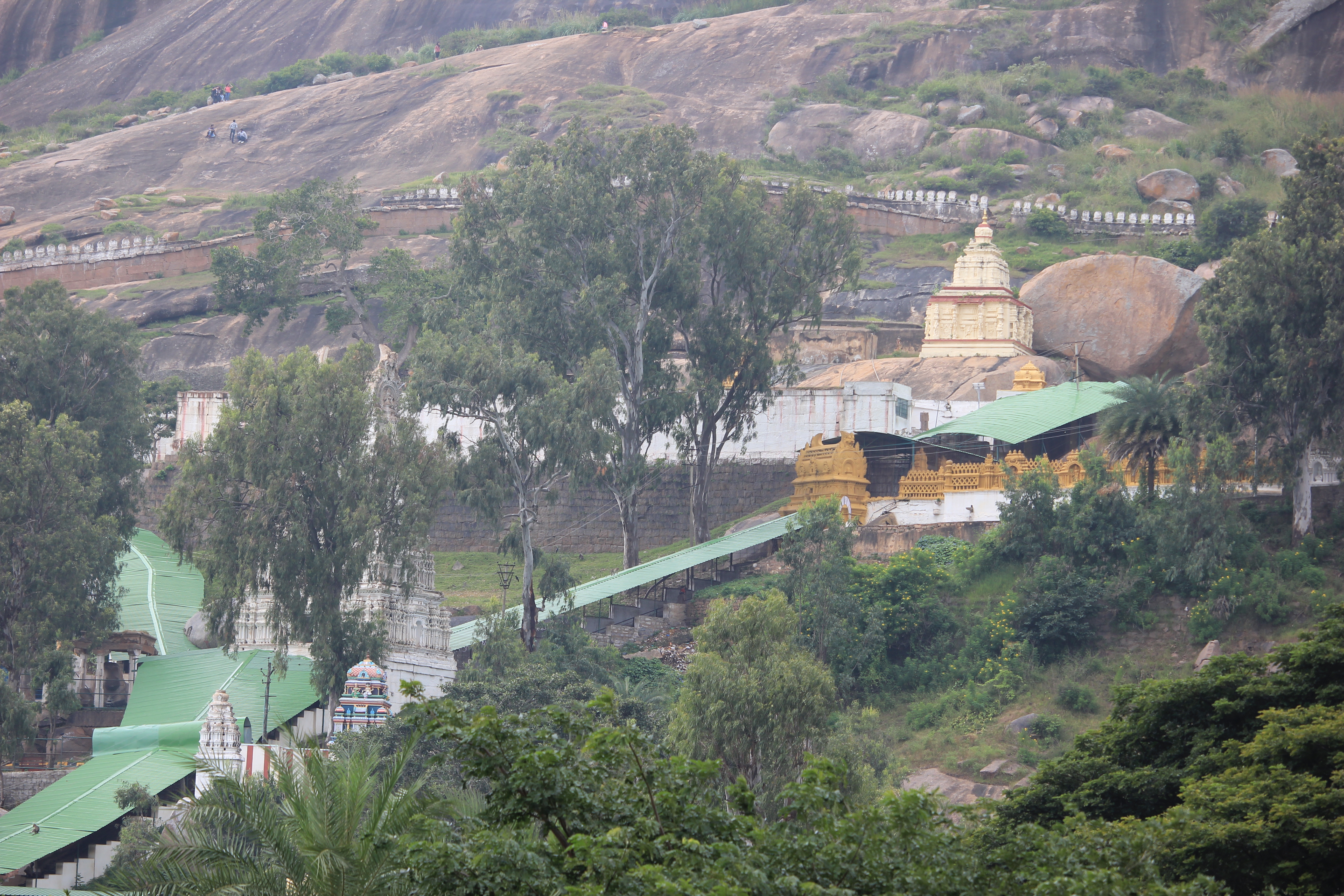
Multilingual AI audio guide exhibit on WOUDiO (PWA). WOUDiO pioneered the world’s first audio guide platform with built-in donation: listeners can support the cultural venue without leaving the listening experience. The text below is the localized description, details, and narration script for this audio guide stop.
Inside the rock the air is cooler and still, and the walls sweat a faint mineral smell. The cave at Gavipuram was not dug by anyone. It is a natural hollow in a single mass of granite, and a shrine to Shiva was fitted into it, so that the walls of the temple are the hill itself.
Legend reaches back much further than any record — to the Vedic age, it is said, and to the sages Gautama and Bharadvaja. What is written down is more human. In the sixteenth century Kempe Gowda, founder of the town on the plateau, fell out with Vijayanagara. His lands were taken, and he was held prisoner for five years by Rama Raya. When he walked free, he built or restored this cave temple in gratitude.
The courtyard outside is crowded with granite. Two enormous discs stand on pillars, one for the sun and one for the moon, beside a stone trident and a stone damaru, the small drum of Shiva. Deeper in, there is a rare image of Agni, the god of fire, with two heads, seven hands and three legs. In 1792 a painter named Thomas Daniell painted the temple, and his picture is how later eyes know what it looked like then.
But the temple's great traveller is the sun.
Once a year, on the evening of Makara Sankranti in mid-January, the setting sun sinks to exactly the right angle over the plateau. Its light slips between the horns of the stone Nandi in the courtyard, crosses the threshold of the cave, and reaches the linga in the darkness within. For a few minutes, the god in the rock is lit by the sky.
Crowds numbering in the lakhs gather for those few minutes — people who have crossed the city, all waiting on a beam of light that has been making the same journey since before any of them were born. In a cloudy year, the light does not come at all, and the crowd goes home and waits another year.
Then the beam slides away up the wall, and the cave returns to its half-dark.
Next January, the sun will set a little further along the horizon each evening until it finds the horns again. From the cave, the road turns back toward the old petes, the market quarters where the town first learned to trade.
Site: Gavi Gangadhareshwara Temple, a Shiva cave temple in Gavipuram
Built: Built or renovated by Kempe Gowda I in the 16th century (a Vedic-age origin is legend)
Key facts: Granite sun and moon discs, trident and damaru in the courtyard; rare two-headed Agni image; at Makara Sankranti (14/15 Jan) the setting sun passes between the Nandi's horns onto the linga for a few minutes; painted by Thomas Daniell in 1792
Map:
Bengaluru map
Official Site:
Karnataka Tourism
Photo: Dineshkannambadi /
Wikimedia Commons (CC-BY-SA-4.0)