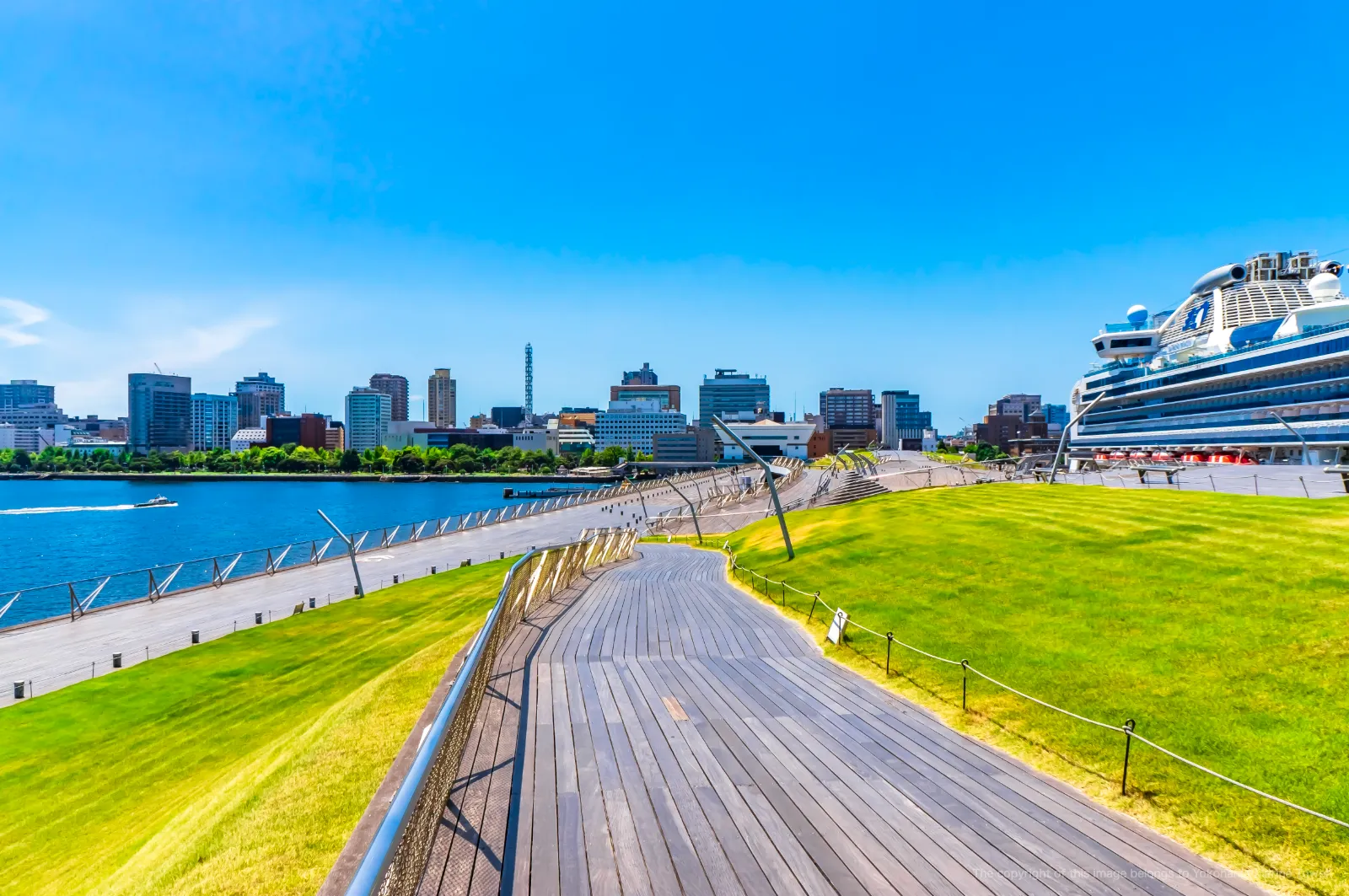
The answer is zero. Not a single column supports that roof. The building spread out below you — Osanbashi Yokohama International Passenger Terminal, with its…
Multilingual AI audio guide exhibit on WOUDiO (PWA). WOUDiO pioneered the world’s first audio guide platform with built-in donation: listeners can support the cultural venue without leaving the listening experience. The text below is the localized description, details, and narration script for this audio guide stop.
The answer is zero. Not a single column supports that roof. The building spread out below you — Osanbashi Yokohama International Passenger Terminal, with its sweeping, fluid curves — was built without a single pillar rising from its vast floor. So what holds up that enormous roof? Welded steel plates, folded as intricately as origami, form a structure in which the very shape itself generates the strength. Not lifted by columns, but held by form. A single undulating plain of steel lies curled across the sea. The design came from FOA — Foreign Office Architects — a London-based architectural collective founded by Alejandro Zaera-Polo and Farshid Moussavi. Selected in 1995 from 660 entries submitted by 41 countries in an international competition, their proposal sent a shock through the architectural world. Their vision was audacious for its time: to dissolve the boundary between building and ground altogether. Because there are no columns to divide the space, the rooftop deck flows seamlessly and gently down to earth, becoming a hillside-like expanse that anyone can stroll up freely. The people of Yokohama came to call this rooftop "the back of the whale." And indeed, looking down from here, doesn't it appear as a single great whale lying quietly in the harbor? Across that broad back, clad in natural timber decking, people are walking today, just as they do every day. The history of Osanbashi itself reaches back to 1894 — the twenty-seventh year of the Meiji era — when it was built as Japan's first modern iron pier. From this very place, tens of thousands of people set sail for foreign shores, and just as many stepped onto Japanese soil for the first time. The anxious hopes of emigrants boarding passage ships, the curious gaze of travelers arriving aboard ocean liners — this pier has endured as the meeting point between Japan and the world. Then, in 2002, on this storied ground, a building of organic form was completed — one that seemed to transcend borders and the walls between cultures. Tear it down and build it anew. That cycle, repeated again and again throughout Yokohama's history, is distilled in its entirety beneath this vast, column-free roof.
Official name:
Yokohama Port Osanbashi International Passenger Terminal
Completed: 2002
Design: FOA (Foreign Office Architects) / Alejandro Zaera-Polo, Farshid Moussavi
Competition: 1995 International Design Competition (selected from 660 entries across 41 countries)
Structure: Integrated welded steel plate construction (column-free open space)
Nickname (rooftop deck): Kujira no Senaka ("The Back of the Whale")
Original pier: Built in 1894 (Meiji 27)
Venue-official content of Yokohama Marine Tower. Supervised by: 横浜マリンタワー 360°.