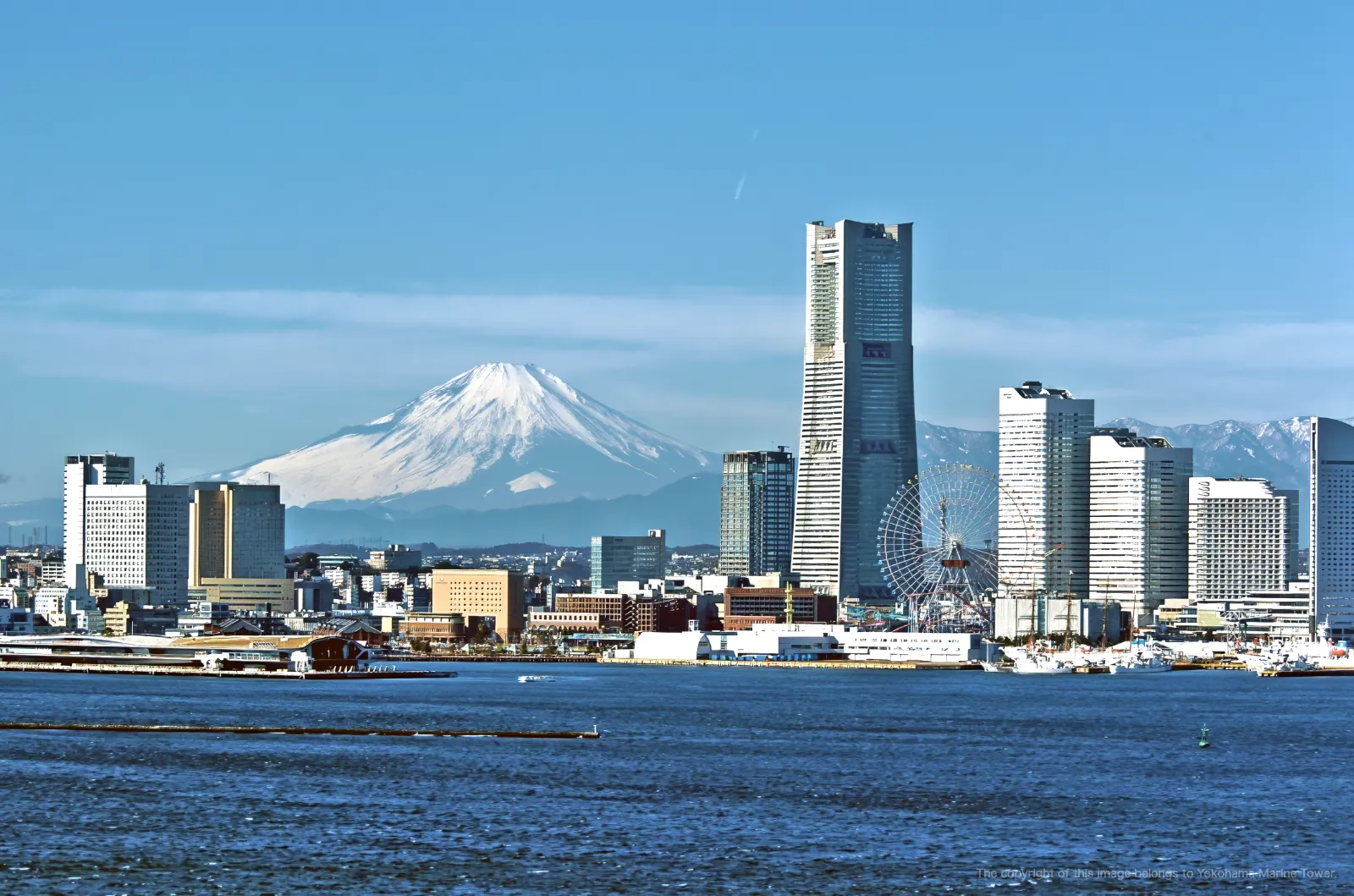
What makes this direction special is not simply that Mount Fuji can be seen from here. Cast your gaze westward from this spot, and you are looking along the very same line of sight that the Edo-period artist
Katsushika Hokusai once followed — a vision of Fuji that traveled from his brush out into the wider world. On a clear day, the ridgeline of Mount Fuji emerges faintly against the western sky. That same direction, Hokusai captured again and again within his creative imagination. Past the age of seventy, he gave the world
*Thirty-Six Views of Mount Fuji*, a series of forty-six prints depicting the mountain from every conceivable angle. Among them, *The Great Wave off Kanagawa* — in which Fuji sits small and serene beyond a fury of towering waves — is perhaps the single most recognized work of Japanese art anywhere on earth. And the sea that swells before that wave is connected to the very waters of Yokohama's coast that you are looking down upon now. Hokusai also painted Fuji as seen from the area around the Kanagawa post town, in prints such as *Tōkaidō Hodogaya*. This view from the Yokohama–Kanagawa direction was, in other words, one of the perspectives that mattered most to him. Then, in the latter half of the nineteenth century, as Japan opened its doors to the world,
ukiyo-e prints began crossing the seas to Europe, where they ignited the passions of painters such as Monet and Van Gogh. In this movement, known as Japonisme, Hokusai's Fuji left a deep impression on the landscape of Western art as well. The mountain rendered in woodblock prints that sailed across the ocean became, for people around the world, one of the defining images of Japan. And one of the places where that journey began lies in the direction your eyes are turned right now. It is said that Mount Fuji is visible from the observation floor of Marine Tower on roughly one hundred days each year. The clearest views come on crisp winter mornings, and at dusk the ridgeline can be washed in shades of orange. If that triangular silhouette is visible to you today, you are in luck. As you gaze in the same direction that Hokusai looked two hundred years ago, allow yourself to sense the vastness of the Fuji he contemplated. And even on days when the mountain cannot be seen, know this: somewhere deep within that sky, Fuji is there.
Work:
Thirty-Six Views of Mount Fuji (46 prints in total)
Artist:
Katsushika Hokusai
Date: c. 1831–1834
Notable prints: The Great Wave off Kanagawa, Fine Wind, Clear Morning, Tōkaidō Hodogaya, and others
Technique: Polychrome woodblock printing (
nishiki-e)
Direction from Marine Tower: West
Days Fuji is visible: Approximately 100 days per year
Elevation: 3,776 m (Kengamine peak)
Distance from observation floor: Approx. 80 km