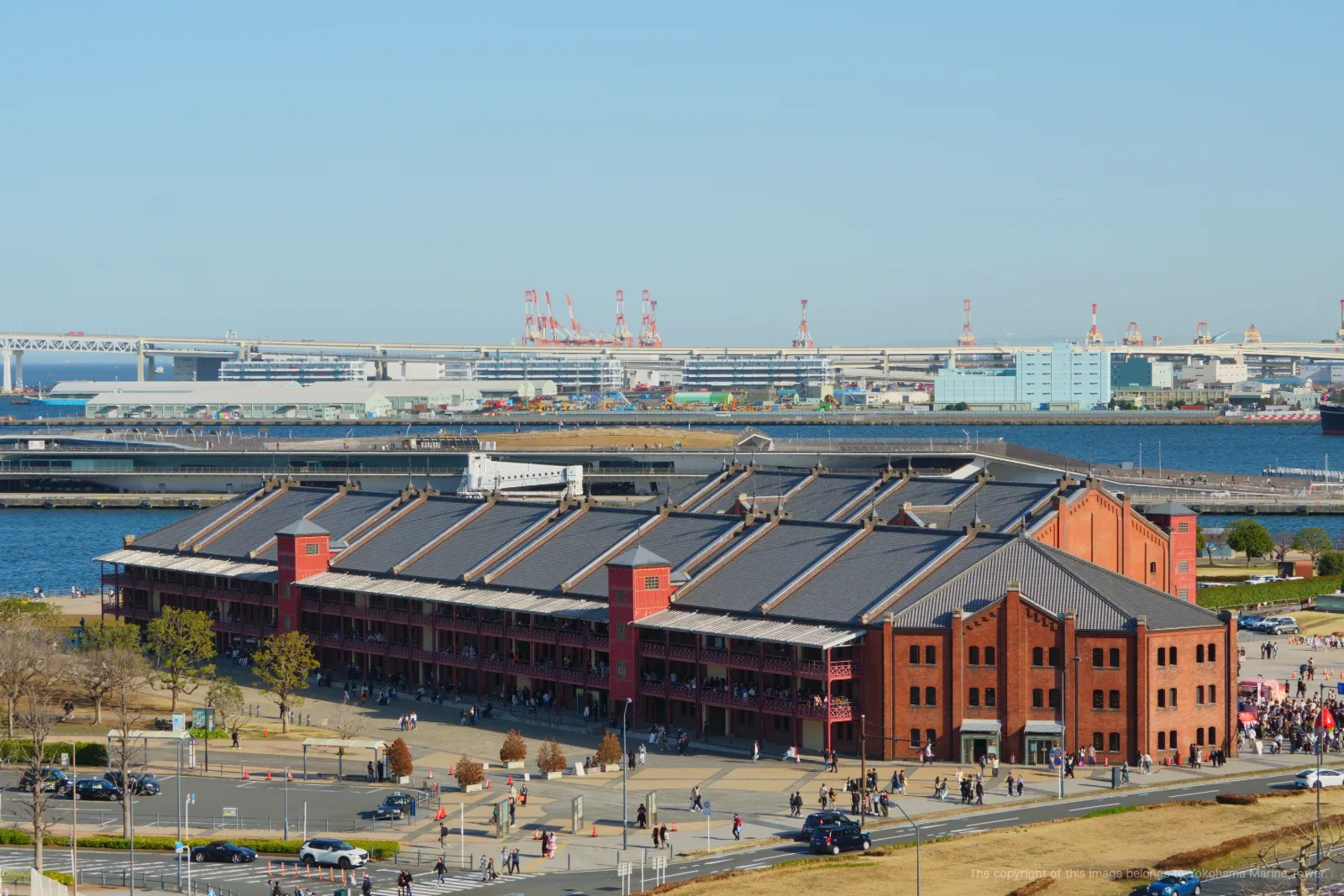
The secret behind the Red Brick Warehouse's survival of the Great Kanto Earthquake lies hidden within its walls — a skeleton of steel concealed inside the…
Multilingual AI audio guide exhibit on WOUDiO (PWA). WOUDiO pioneered the world’s first audio guide platform with built-in donation: listeners can support the cultural venue without leaving the listening experience. The text below is the localized description, details, and narration script for this audio guide stop.
The secret behind the Red Brick Warehouse's survival of the Great Kanto Earthquake lies hidden within its walls — a skeleton of steel concealed inside the brickwork. Along the waterfront to the west of
Osanbashi Pier, two deep reddish-brown buildings stand side by side. These are the Yokohama Red Brick Warehouses. Warehouse No. 1 was completed in 1913, and No. 2 two years earlier, in 1911. Their designer was Tsumaki Yorinaka, a construction engineer with the Ministry of Finance — and he employed a technique that was extraordinarily rare in Japan at the time. Steel beams and columns were embedded within the brick exterior walls, forming a flexible framework that supported the entire structure from within. Iron rods were also threaded between the layers of brickwork to reinforce them, preventing the bricks from scattering and crumbling apart under the shaking of an earthquake. It was, in essence, a dual structure — a rigid armor of brick on the outside, with a supple skeleton of steel quietly concealed within. In this, Tsumaki anticipated the philosophy of earthquake-resistant architecture that would only come into its own much later. On the first of September, 1923, when the Great Kanto Earthquake struck Yokohama, buildings around it collapsed one after another — yet Warehouse No. 2 emerged almost entirely unscathed. Warehouse No. 1 was, regrettably, half-destroyed, leaving it with the shorter form we see today; and yet even it was spared complete ruin. Tsumaki's remarkably forward-looking vision had shielded those brick walls through the very worst. But as the tides of time shifted, the warehouses outlived their purpose as storage facilities and fell into a long, quiet slumber. They were awakened once more in 2002 — reborn as a complex of commercial and cultural spaces, and welcomed into a new life as a symbol of Yokohama. A building that survived catastrophic destruction, now living a second life as a place where people come together and smile. In each and every one of those red bricks, the memory of Yokohama's devastation and rebirth — spanning more than a century — is quietly inscribed. If the sunlight happens to be falling on those walls as you look upon them now, let that warm, deep red burn itself into your memory. That color is nothing less than the will of this city — a city that has risen, again and again, no matter what.
Completion: Warehouse No. 1 — 1913 (Taishō 2); Warehouse No. 2 — 1911 (Meiji 44)
Architect: Tsumaki Yorinaka (Temporary Construction Division, Ministry of Finance)
Structure: Brick construction with integrated steel-frame and iron reinforcement
Change of use: Bonded warehouse → revived as commercial and cultural facility in 2002
Location: 1-chome, Shinko, Naka-ku, Yokohama
Designations: Yokohama Certified Historic Building (both warehouses, 2002); Heritage of Industrial Modernization (2007)
Venue-official content of Yokohama Marine Tower. Supervised by: 横浜マリンタワー 360°.