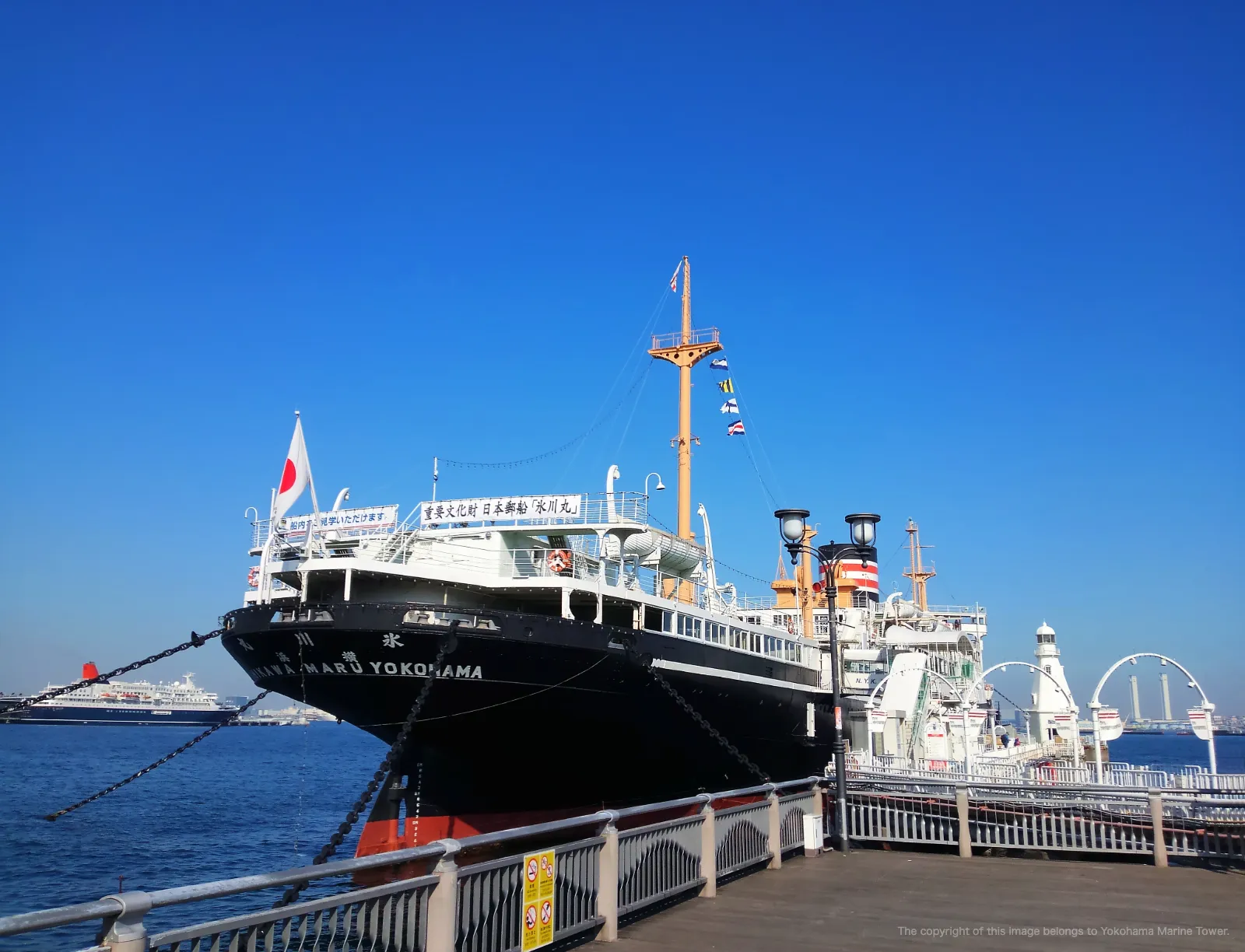
Along the quay of Yamashita Park, a dark-hulled ship lies quietly at her moorings. This is the Hikawa Maru. And the most celebrated soul ever to sail aboard…
Multilingual AI audio guide exhibit on WOUDiO (PWA). WOUDiO pioneered the world’s first audio guide platform with built-in donation: listeners can support the cultural venue without leaving the listening experience. The text below is the localized description, details, and narration script for this audio guide stop.
Along the quay of Yamashita Park, a dark-hulled ship lies quietly at her moorings. This is the Hikawa Maru. And the most celebrated soul ever to sail aboard her? The answer is Charlie Chaplin. In 1932, the king of comedy — a man who had captivated the entire world — chose this very ship to carry him across the Pacific. She plied the North Pacific route between Seattle and Yokohama, and she did so in extraordinary style. The Hikawa Maru was the pride of Nippon Yusen Kaisha: a passenger-cargo liner whose first-class cabins were fitted in the elegant Art Deco manner, a grand hotel unto herself, gliding across the open sea. Imagine Chaplin strolling those decks, dining in the saloon, settling into a deck chair to gaze at the Pacific horizon stretching endlessly before him. Yet the life of the Hikawa Maru was not one of glamour alone. Launched on the Seattle route in 1930, celebrated as the jewel of the Pacific, she would be given an entirely different purpose by war. During the Pacific War, the Hikawa Maru was requisitioned as a naval hospital ship. Her hull was repainted white and marked with the Red Cross, and she became a vessel bearing the wounded and the broken. From a gleaming ocean liner to a ship laden with suffering and prayer — the same hull carried the weight of two utterly different ages. She struck mines three times. Three times, she refused to sink. Of all the large passenger-cargo ships in the Nippon Yusen fleet, the Hikawa Maru alone survived the war. Afterward, she returned to the Pacific run, sailing on in active service until 1960. Upon her retirement, she was moored at Yamashita Park in Yokohama — the very city where she was born — and there she has remained ever since. That dark hull has known both splendor and devastation, both joy and pain. It has known the sound of Chaplin's laughter, and the silence of a hospital ship at sea. After more than ninety years, the Hikawa Maru still floats in that same place, bearing on her iron skin everything the port of Yokohama has ever witnessed.
Built: Completed 1930 (Showa 5)
Shipyard: Yokohama Dock Co., Ltd.
Gross Tonnage: 11,622 tons
Length: 163.3 m
Route: Seattle Route (Yokohama – Seattle)
Notable Passenger: Charlie Chaplin (1932)
Wartime Role: Requisitioned as a naval hospital ship
Mooring: Permanently moored at Yamashita Park since 1961
Designation: Annex of the NYK Maritime Museum; Important Cultural Property (designated 2016)
Venue-official content of Yokohama Marine Tower. Supervised by: 横浜マリンタワー 360°.