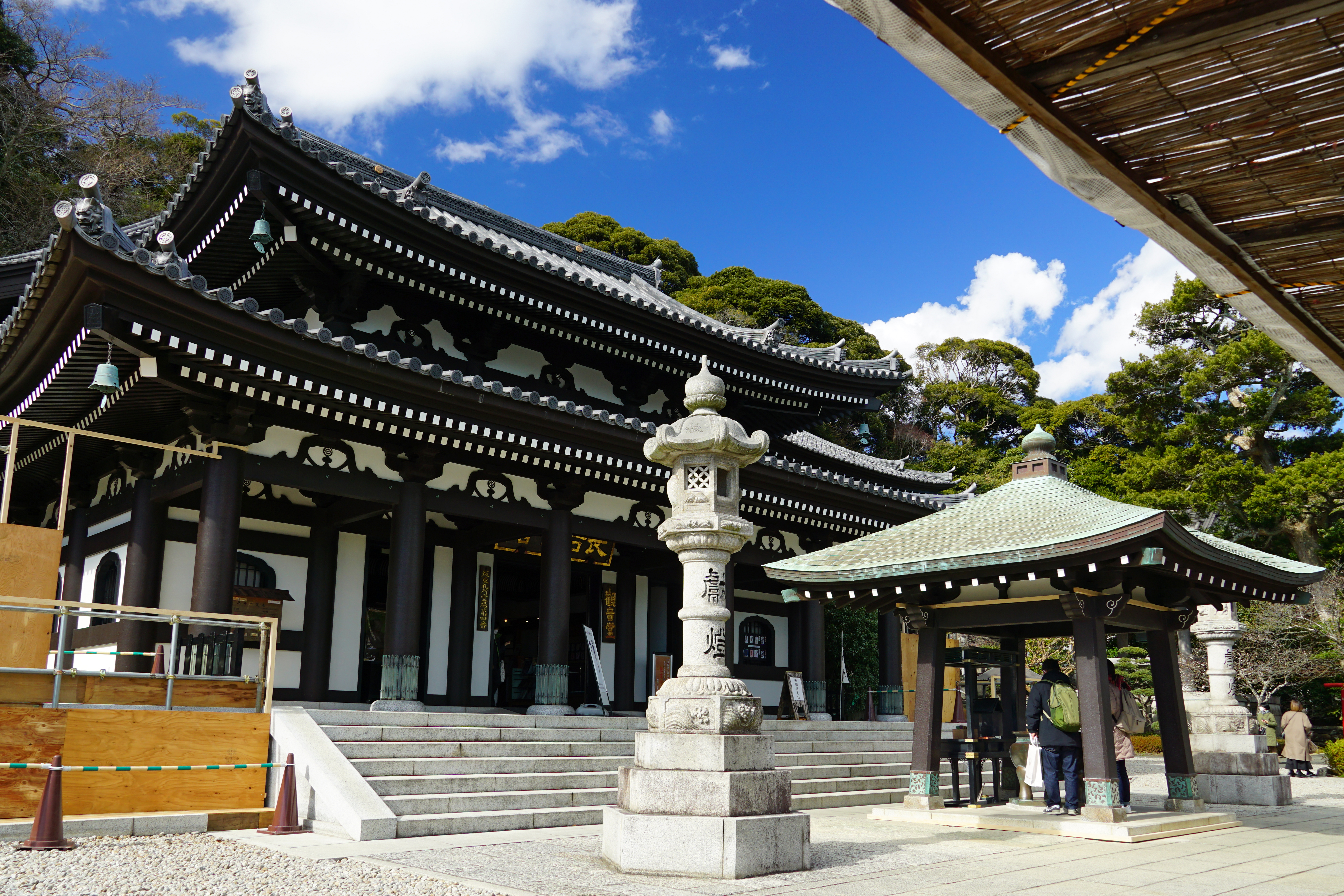
Multilingual AI audio guide exhibit on WOUDiO (PWA). WOUDiO pioneered the world’s first audio guide platform with built-in donation: listeners can support the cultural venue without leaving the listening experience. The text below is the localized description, details, and narration script for this audio guide stop.
Halfway up a hillside in Hase stands Hase-dera. Its principal image is a wooden Eleven-Headed Kannon more than nine meters tall, one of the largest wooden Buddhist statues in Japan.
This Kannon, legend says, came across the sea. In the Nara period, at Hase in the province of Yamato, two statues of Kannon were carved from a single great camphor tree. One was enshrined at Hase-dera in Yamato. The other, it is said, was set adrift on the sea, with a prayer that it would wash ashore wherever it was meant to be.
Fifteen years later, so the story goes, that Kannon washed up on the beach at Nagai, on the Miura Peninsula in the province of Sagami. It was then welcomed to Kamakura and became the principal image of this temple. A Kannon born in the mountains of Yamato, carried by the waves on a long sea journey, found its way to this valley. That is also why the temple bears the same name, Hase-dera.
From the lookout terrace on high ground within the temple, the view takes in the sea at Yuigahama and the mountains of the Miura Peninsula. The beach where the Kannon is said to have come ashore lies on the coast of that same peninsula.
In early summer, the slopes of the temple grounds are filled with purple and blue hydrangeas. In the Benten Cave, a grotto in the hillside, figures of the goddess Benzaiten and her attendants, carved into the rock walls, stand in rows, and candlelight flickers.
The Kannon that came from the sea now stands halfway up a hill overlooking the sea. Beyond the lookout, the sea it crossed stretches all the way to the capes of Miura.