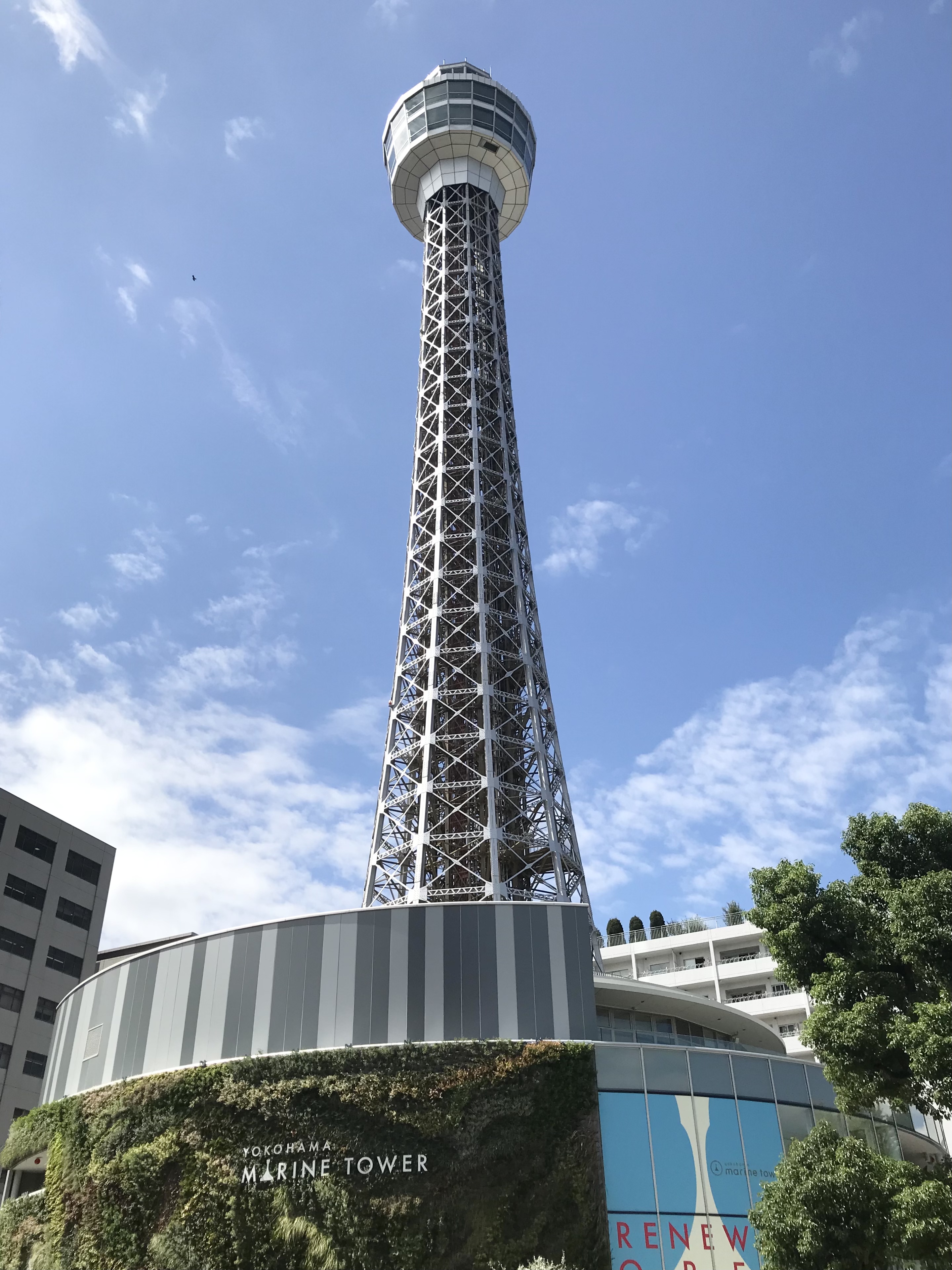
Yokohama Marine Tower — Timeline
1854 Treaty of Kanagawa signed / 1854 Beginnings of the Foreign General Cemetery / 1859 Port of Yokohama opens / 1859 Origins of Chinatown / 1863〜1875 British…
1854 — Treaty of Kanagawa signed
Following the return of Commodore Perry's fleet, the Japan–US Treaty of Peace and Amity was signed at Yokohama village, near today's Kaiko Hiroba Park. It marked Japan's first step toward opening to the world.
1854 — Beginnings of the Foreign General Cemetery
A sailor from the USS Mississippi of Perry's fleet died and was buried on the hill overlooking the harbor. This became the origin of a cemetery where people of more than 40 nationalities now rest.
1859 — Port of Yokohama opens
Under the Treaty of Amity and Commerce and related treaties, the Port of Yokohama opened to foreign trade. From then on, many new cultures and technologies entered Japan through this port.
1859 — Origins of Chinatown
With the opening of the port, Chinese people from Guangdong, Shanghai and elsewhere began living in a corner of the foreign settlement, acting as intermediaries between Western and Japanese merchants.
1863〜1875 — British and French troops on the Bluff
Amid tensions heightened by incidents such as the Namamugi Incident of 1862, French and British troops were stationed on the hill overlooking the harbor until 1875. The hill opened as Harbor View Park in 1962.
1866 — Negishi Racecourse established
Foreign residents built a racecourse on the Negishi hills, the starting point of modern horse racing in Japan. Its first-class grandstand was added in 1930.
1867〜1899 — Yamate foreign settlement
The Yamate hill became a foreign settlement, lined with Western-style houses, churches and schools. The settlement system was abolished in 1899 following treaty revision.
1872 — Japan's first railway opens
Japan's first railway opened between Shimbashi and Yokohama (near today's Sakuragicho Station). The same year, gas street lamps were first lit in Yokohama.
1906 — Sankeien Garden opens to the public
Hara Sankei, who made his fortune in the raw silk trade, opened his Honmoku garden to the public. It gathers historic buildings relocated from across Japan.
1911〜1913 — Red Brick Warehouses completed
Designed by Tsumaki Yorinaka, Warehouse No. 2 was completed in 1911 and No. 1 in 1913. Their iron-reinforced structure saved them from total collapse in the Great Kanto Earthquake.
1923 — Great Kanto Earthquake
On September 1, the Great Kanto Earthquake struck. Most of Yokohama's urban area collapsed or burned, and a long reconstruction began.
1927 — Hotel New Grand opens
Carrying on the spirit of the Grand Hotel lost in the earthquake, it opened as a symbol of reconstruction. It is also known as the birthplace of doria and spaghetti Napolitan.
1927 — "Blue-eyed dolls" cross the ocean
As a token of friendship, about 12,000 dolls were sent from the United States to Japan, and Japan sent 58 "friendship dolls" in return. The Yokohama Doll Museum conveys this history of exchange through dolls.
1930 — Hikawa Maru enters Seattle service
The NYK cargo-passenger liner began sailing between Yokohama and Seattle. Charlie Chaplin sailed on her in 1932; after serving as a hospital ship in wartime, she remained in service until 1960.
1930 — Yamashita Park opens
Built on seafront land reclaimed with rubble from the Great Kanto Earthquake, Yamashita Park was completed as a symbol of recovery.
1945 — Yokohama air raid and the occupation
The air raid of May 29 burned large parts of the city. After the war, much of the port and city center was requisitioned by the Allied forces, and its return to citizens took many years.
1961 — Yokohama Marine Tower opens
Built to commemorate the centennial of the Port of Yokohama, the 106-meter Yokohama Marine Tower opened in January. A lighthouse at its top guided ships at night.
1963 — Yamashita Pier completed
Yamashita Pier was completed as a logistics hub of about 47 hectares, supporting the Port of Yokohama during Japan's high-growth era. Plans for its redevelopment are now under discussion.
1978 — Yokohama Stadium completed
On the grounds of Yokohama Park — once used by settlement foreigners and requisitioned by the Allied forces after the war — Yokohama Stadium was completed with funding from citizens and local businesses.
1989 — Yokohama Expo and Minato Mirai
The Yokohama Exposition was held on land including the former Mitsubishi Heavy Industries Yokohama Shipyard, drawing more than 13 million visitors. Development of the Minato Mirai 21 district gathered pace.
1989 — Yokohama Bay Bridge opens
The 860-meter cable-stayed bridge opened as a new gateway to the port. Its clearance of about 55 meters above the sea later affected the entry of large cruise ships.
2001 — The return of Ariake's "Harbour"
Yokohama's beloved cake "Harbour," which vanished after the company's bankruptcy in 1999, returned on April 26 after a revival campaign by citizens. Yokohama Marine Tower was one of the venues for the announcement.
2002 — Osanbashi International Passenger Terminal completed
At Osanbashi Pier, first built in 1894 as Japan's first modern iron pier, a new terminal with a column-free, undulating roof was completed. The same year, the Red Brick Warehouses reopened as commercial and cultural facilities.
2008 — The lighthouse goes dark
The lighthouse at the top of the tower shone for the last time in the early hours of July 28 and was officially decommissioned on September 1. Its Fresnel lens was taken down and is now displayed on the ground floor.
2009 — Marine Tower reopens under the City of Yokohama
After closing in December 2006, the tower was acquired and renovated by the City of Yokohama, reopening on May 23 in the year of the port's 150th anniversary.
2022 — Second renewal reopening
After closing at the end of March 2019 for renovation, the tower reopened on September 1 with refreshed spaces, including its observation floors.