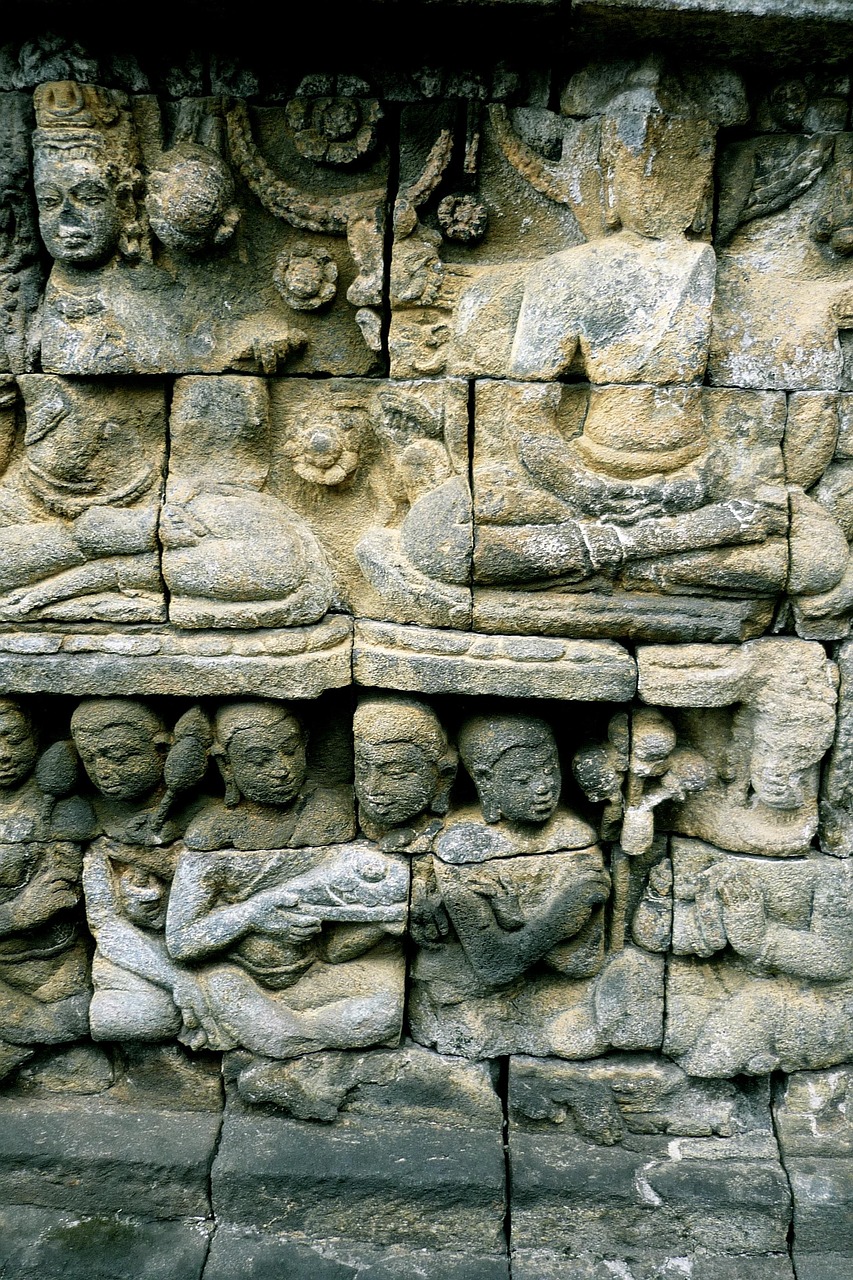
At the top of the stone stairs, the walls disappear. The galleries that ran on and on until now — stories carved in stone, the parables of sages, reliefs in…
Multilingual AI audio guide exhibit on WOUDiO (PWA). WOUDiO pioneered the world’s first audio guide platform with built-in donation: listeners can support the cultural venue without leaving the listening experience. The text below is the localized description, details, and narration script for this audio guide stop.
At the top of the stone stairs, the walls disappear.
The galleries that ran on and on until now — stories carved in stone, the parables of sages, reliefs in endless procession — suddenly draw back to either side. What remains is only the sky, and a round, open ground.
This is
Arupadhatu, the formless realm — the highest region of
Borobudur. A plateau reached only by those who have passed through
Kamadhatu, steeped in desire, and made their way through the galleries of
Rupadhatu, colored by things that have form. Three circular terraces spread out quietly, like the rings from a single drop falling onto still water.
And then comes the realization: no story has been carved here to be told. No walls. No pictures. That is not something missing. It means that words, forms and colors have all been spoken to the end. This is the place where a soul that has left everything behind can at last stand.
On the round terraces,
stupas shaped like upturned bells stand one after another. Within the openwork lattice of each sits a Buddha, perfectly still. Yet never fully visible — half-hidden between light and shadow. Seen for a moment, then gone; gone, and then only a presence returns.
Whoever has walked this far already knows: the teaching was never something to grip tightly, but something to loosen, little by little.
At the close of the eighth century, the people who designed this round plateau entrusted to space itself what words could not carry. Using form to show formlessness. Using a voice to speak of silence. Twelve hundred years on, that paradox is still holding its breath here.
The stone no longer tells anything. There is only the sky, simply there.
Site: Arupadhatu (circular terraces), Borobudur Temple
Built: Late 8th–early 9th century, Shailendra dynasty
Structure: Three circular terraces ringed by 72 openwork stupas, with the great stupa at the summit
Symbolism: A state beyond form and color (Arupadhatu), the highest layer of the mandala
Location:
Magelang Regency, Central Java
Inscription: UNESCO World Heritage Site (1991)
Official Site:
Borobudur - Indonesian Heritage Agency
Photo: masbebet /
Pixabay (pixabay)