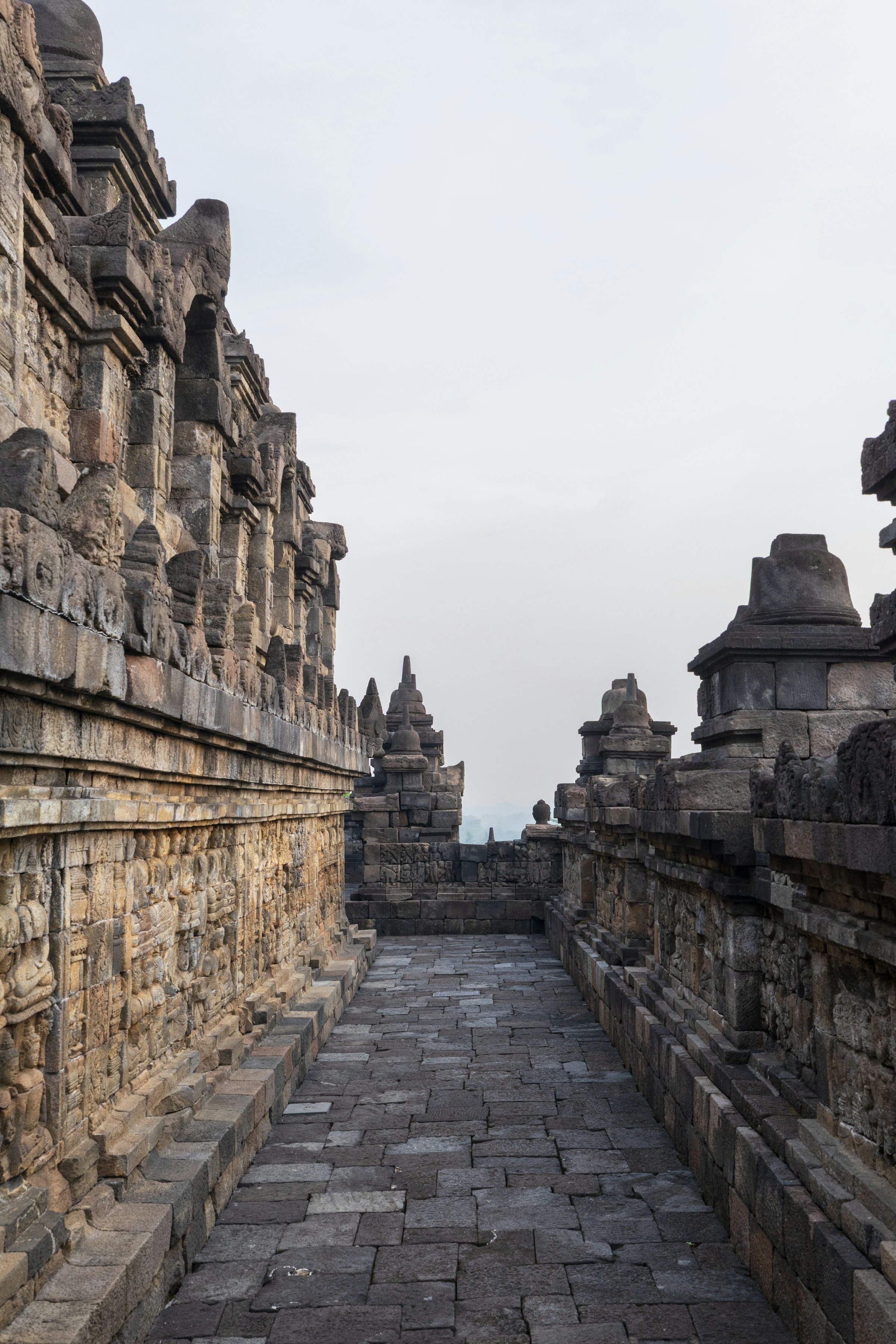
A barefoot pilgrim reads the unevenness of the stone through the soles of the feet — the same stone that centuries of feet have walked smooth. The galleries of…
Multilingual AI audio guide exhibit on WOUDiO (PWA). WOUDiO pioneered the world’s first audio guide platform with built-in donation: listeners can support the cultural venue without leaving the listening experience. The text below is the localized description, details, and narration script for this audio guide stop.
A barefoot pilgrim reads the unevenness of the stone through the soles of the feet — the same stone that centuries of feet have walked smooth.
The galleries of
Borobudur never once let anyone walk straight ahead. A full circuit brings the pilgrim back to the direction of departure; then one level up, and the walking begins again. The same wall, traced once more — only now from a tier higher. Less a spiral than a repetition that climbs: a slow road, taken over a long time, like peeling back the layers of oneself.
This long way round has a purpose. Built by the people of the
Shailendra dynasty between the eighth and ninth centuries, the monument took a
mandala drawn on a flat surface and reworked it into a solid that can be walked through. On the lower levels are carved the stories of a world full of desire —
Kamadhatu. With each tier climbed, the reliefs on the walls shift quietly: from suffering to moral precept, and on to the life and teachings of the Buddha, moving toward enlightenment.
The walls were never meant simply to be looked at. The
reliefs are set out in the order of the story, for those who walk clockwise with the right shoulder turned toward the center of the monument. A pilgrim would stop before one panel, then move on to the next. The story was received not by reading, but by walking. The gallery was a scripture made of stone.
Not hurrying — perhaps that in itself was part of what this place taught. Circuit after circuit, the legs grow heavy, the breath evens out, and the waves in the heart slowly settle. Not the distance, but the act of walking itself is what changes something.
The edges of the stone steps have been rounded, ever so slightly, by countless feet. Every one of those small curves was someone's circuit. The stone is still waiting for the next step, at the same unchanging height.
Location: Galleries of Borobudur Temple (Central Java, Indonesia)
Built: 8th–9th century, Shailendra dynasty
Structure: Three-dimensional mandala / three realms (Kamadhatu, Rupadhatu, Arupadhatu)
Gallery reliefs: The life and teachings of the Buddha, arranged clockwise
Pilgrimage practice: Pradakshina (clockwise circumambulation, keeping the monument on the right)
Map:
Map
Official Site:
Borobudur Park
Photo: Rowan Heuvel /
Unsplash (unsplash)