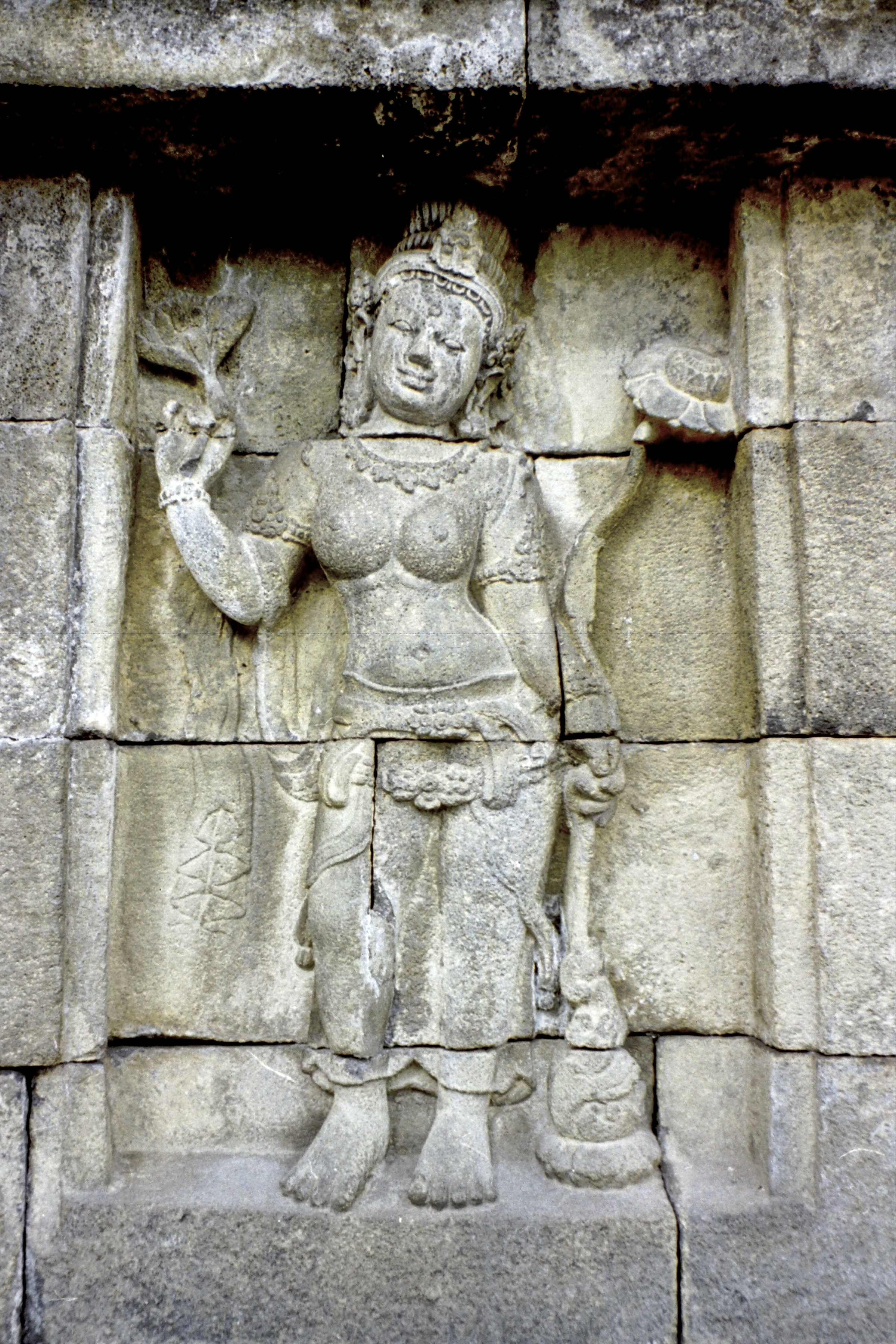
A man at the market is cheating on his scales. Only a little — one finger resting against the weight, sure that no one is watching. More than a thousand years ago, that tiny movement of a fingertip was carved into the wall of a hidden gallery at
Borobudur.
What the craftsmen of
Java carved first was neither enlightenment nor a paradise in the heavens. Along the inner face of the
base — the lowest place of all, later covered over, reliefs and all — stand ordinary human beings: people who crave, who take, who deceive, and who reap what they have sown. This is the
Karmavibhangga, a chain of stories about deeds and their consequences. People fishing, trading, quarrelling. A woman in her finery; a man drunk on wine. Their faces — the laughter, the sighs — still breathe quietly in the stone, across twelve hundred years.
Why should a pilgrim's road begin in a place like this? Perhaps the lesson was this: before rising toward heaven, first come to know the self that lives on the ground. Shaken by desire, falling into error, and living on regardless — that was the very self everyone had to let go of first.
The masons who carved this wall must have haggled at the market too, drunk their wine, and now and then got the better of someone. People with the same weaknesses as their own — they carved them not with a line that judges, but with the line of someone sketching a familiar neighbor.
Not long after completion, this
hidden base was sealed behind new stone and vanished from human sight. Some say it was to strengthen the foundation; others, that these were scenes never meant to be shown. The crowd of sleeping figures would not feel the light again until more than a thousand years later, in 1885.
They were not carved in order to be judged. They are there to be forgiven, and to move on. That fingertip is still touching the scale — inside the stone, for more than a thousand years, weighing the same weight.
Location: Hidden base (Karmavibhangga reliefs), Borobudur Temple, Central Java, Indonesia
Theme: Kamadhatu, the realm of desire (lowest of the three realms), and stories of cause and effect
Reliefs: Karmavibhangga (a series depicting deeds and their karmic results)
Construction: 8th–9th century, Shailendra dynasty
Notes: Covered with stone after completion; discovered in 1885, then photographed and documented in 1890–91
Map:
Borobudur
Official Site:
Borobudur - Taman Wisata Candi
Photo: Bill Fairs /
Unsplash (unsplash)