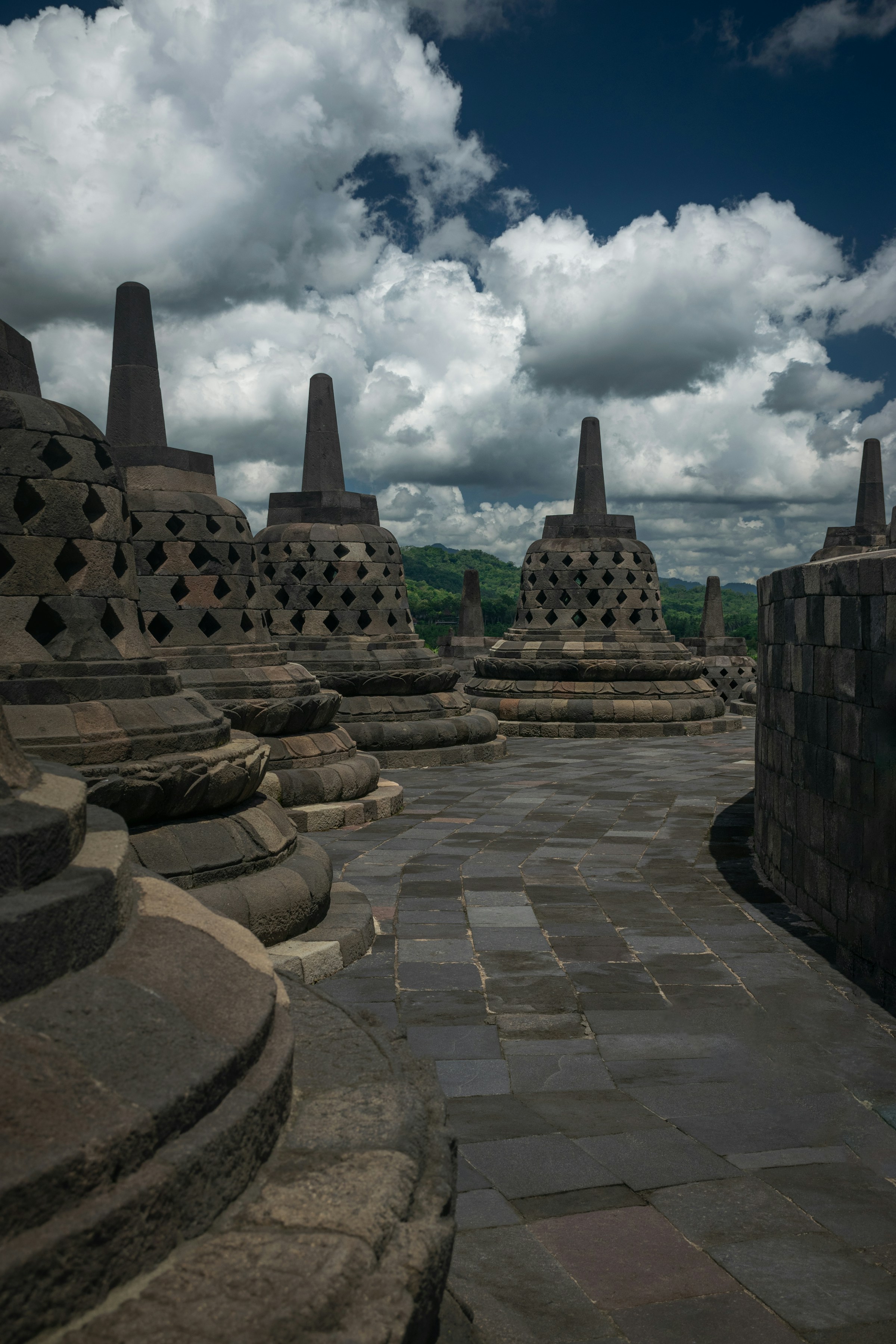
Before dawn, under a sky still scattered with stars, hundreds of men were cutting stone. Block after block of greyish andesite was hauled up to a hill…
Multilingual AI audio guide exhibit on WOUDiO (PWA). WOUDiO pioneered the world’s first audio guide platform with built-in donation: listeners can support the cultural venue without leaving the listening experience. The text below is the localized description, details, and narration script for this audio guide stop.
Before dawn, under a sky still scattered with stars, hundreds of men were cutting stone. Block after block of greyish
andesite was hauled up to a hill overlooking a valley in central
Java. Behind them, two volcanoes —
Mount Merapi and
Mount Merbabu — were slowly exhaling plumes of white smoke.
A land where the ground trembles, where ash sometimes falls like rain. Most people would flee a place like this. One dynasty chose it deliberately. At the end of the
8th century, the region was ruled by the
Shailendra dynasty — a name that means "Lord of the Mountain." To them, a volcano was a threat, but it was also a sacred height where the gods dwelt.
The kings did not want an ordinary temple. They wanted to build the world itself in stone. On this hill, which would come to be called
Borobudur, they set out to carve a miniature of the cosmos.
So why pour so much labor into the foot of a mountain that breathes fire? Because soil laced with volcanic ash is rich, and the rice grew in abundance. The wealth of that rice carried a construction that stretched on for decades. The earth that gave the harvest was the same earth that could swallow everything.
The stonemasons split the rock with iron chisels and dressed each face, one block at a time. They used no nails and no mortar; every block was fitted to the next, interlocking like joinery in timber. Some
2 million stones were raised by human hands alone.
Among the lines of people carrying stone, there must have been boys still in their teens. A rope biting into one shoulder; the low growl of the mountain at his back. In his whole lifetime, perhaps he saw only a few tiers of that long road to completion.
Most of the kings' names now survive only in fragments of inscriptions.
The mountain they believed in is still quietly breathing out its smoke.
Subject: The origins of construction under the Shailendra dynasty
Period: Late 8th–9th century
Dynasty: Shailendra dynasty (meaning "Lord of the Mountain")
Location:
Borobudur, Central Java, Indonesia
Geography: Volcanic zone of Mount Merapi and Mount Merbabu; fertile volcanic-ash soil
Material: About 2 million andesite blocks, laid without nails or mortar
Heritage: UNESCO World Heritage Site (inscribed 1991)
Official Site:
UNESCO World Heritage Centre
Photo: Filipe Freitas /
Unsplash (unsplash)