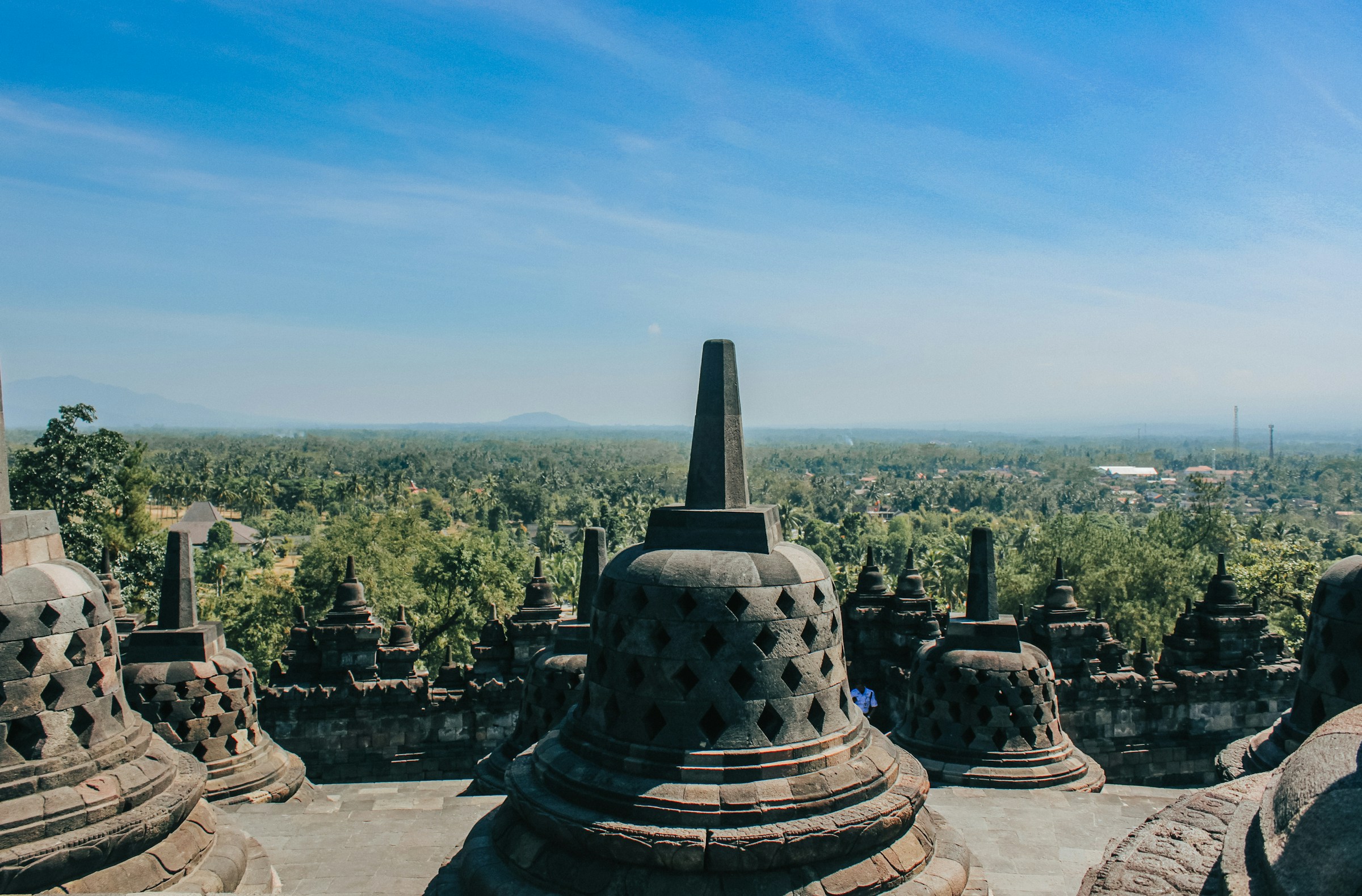
If stone could be stacked to build the very shape of a prayer, space and all — then twelve hundred years ago, people did exactly that.
Borobudur is not simply a building. It is a world in which the
mandala, usually drawn on paper, has been raised whole into three dimensions, so that it can be walked, step by step.
From above, it is as orderly as a precise geometric figure. But people are not birds. To pilgrims arriving on foot, the whole was never visible. Without seeing it, they circled one gallery, then climbed to the next level. Walking itself was the device that carried the heart upward, one tier at a time.
The temple was built as three worlds laid one upon another. The lowest is the world of desire, the world of our everyday lives —
Kamadhatu. The square galleries in the middle belong to a world of stillness, where form remains but desire has fallen away —
Rupadhatu. And nearer the summit, ornament disappears, until only round terraces remain, opening toward the sky: a world that has let go even of form —
Arupadhatu. A path marked out in squares grows rounder the higher it rises. That change is an architectural design, and at the same time it is the transformation of the heart itself, told in stone.
From angular doubt to round stillness. At every turn of a gallery, the view is closed off for a moment by a wall, then opens again. Closing and opening, over and over — and without noticing, the pilgrim's breathing grows even. The architecture leads people gently on.
Twelve hundred years ago, the pilgrim who first set foot on its stone steps must have carried stillness and exhilaration together — that sense of walking, one step at a time, inside the very shape of a prayer. That person's name survives nowhere. But the first step they took is still in the same place.
Name: Borobudur Temple (Candi Borobudur)
Structure: Three-dimensional mandala / three-realm structure (Kamadhatu, Rupadhatu, Arupadhatu)
Built: 8th–9th century, Shailendra dynasty
Form: Square galleries on the lower levels, circular terraces above
Location:
Magelang Regency, Central Java
Official Site:
Borobudur Park
Photo: Eugenia Clara /
Unsplash (unsplash)