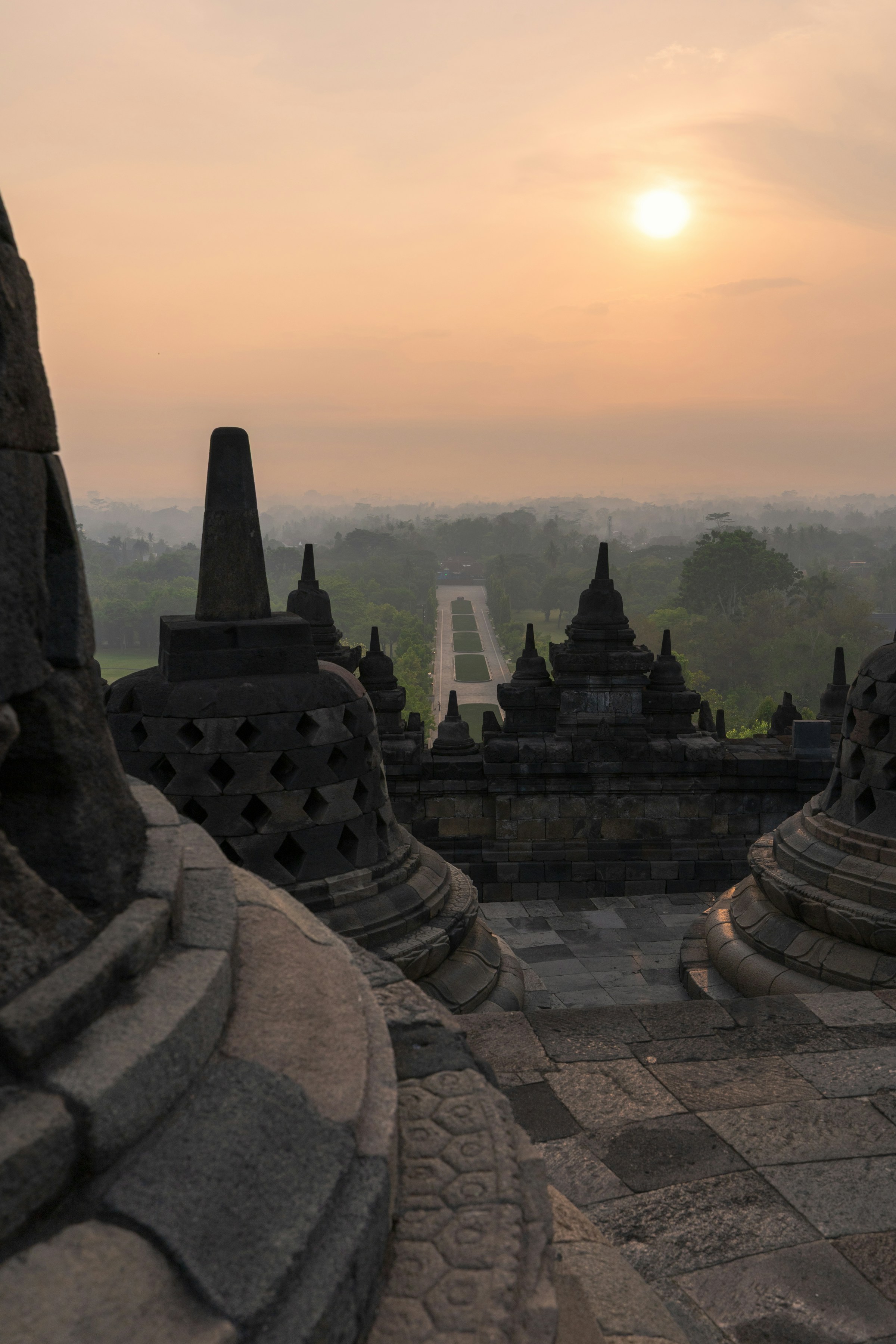
The footsteps of a pilgrim coming down the stone stairs, one step at a time, should have sounded just as they did on the way up — and yet they must have rung somehow differently. After circling the
galleries, following the life of the Buddha, and melting into the sky beside the bell-like towers of the summit, the same stone and the same wind would already have become something else.
For the people of the
Shailendra dynasty who built
Borobudur, this was never simply a structure. From the world of desire that crawls along the ground, to the world of things with form, and on to a stillness beyond form — it was a mandala translated straight into stone, a device of prayer to be climbed on foot. And whoever reached the top had to come down again.
Why? One who has drawn close to enlightenment does not remain at the summit, but returns to the world below. In Buddhism, this was understood as a journey back to those who still carry sorrow. What is gained at the summit is not meant to be kept for oneself, but carried back down to the foot of the mountain.
Countless footprints overlap on this way down. Those who dug the ruins out of the jungle after a thousand years asleep beneath volcanic ash. Those who, in the
19th century, brought it back to the world's attention. Those who gave their lives to the restoration of the
20th century, numbering the crumbling stones one by one and setting them back in place. And, long before them all, the nameless pilgrims who pressed these stones with bare feet and prayed as their eyes followed the stories in the reliefs. They, too, climbed — and came back down.
Beyond the gate, the sky of Java spreads wide. Volcanoes stand in a quiet line in the distance, and the green of the rice fields sways in the morning light. The summit the pilgrim had just left must already have seemed far away, as if it had become part of the sky.
Perhaps the place truly climbed was never the stone tower. Something that quietly opened within a person while following the stories — that, perhaps, was the true summit of this mountain.
Even after the descent, the light received at the summit is still walking on, inside someone.
Location:
Borobudur Temple exit and approach path
Built: 8th–9th century, Shailendra dynasty
Structure: A mandala giving three-dimensional form to the three realms (Kamadhatu, Rupadhatu, Arupadhatu)
Rediscovery & Restoration: Rediscovered in the 19th century; large-scale restoration in the 20th century
Status: UNESCO World Heritage Site
Official Site:
Borobudur - UNESCO World Heritage Centre
Photo: Rowan Heuvel /
Unsplash (unsplash)