In the
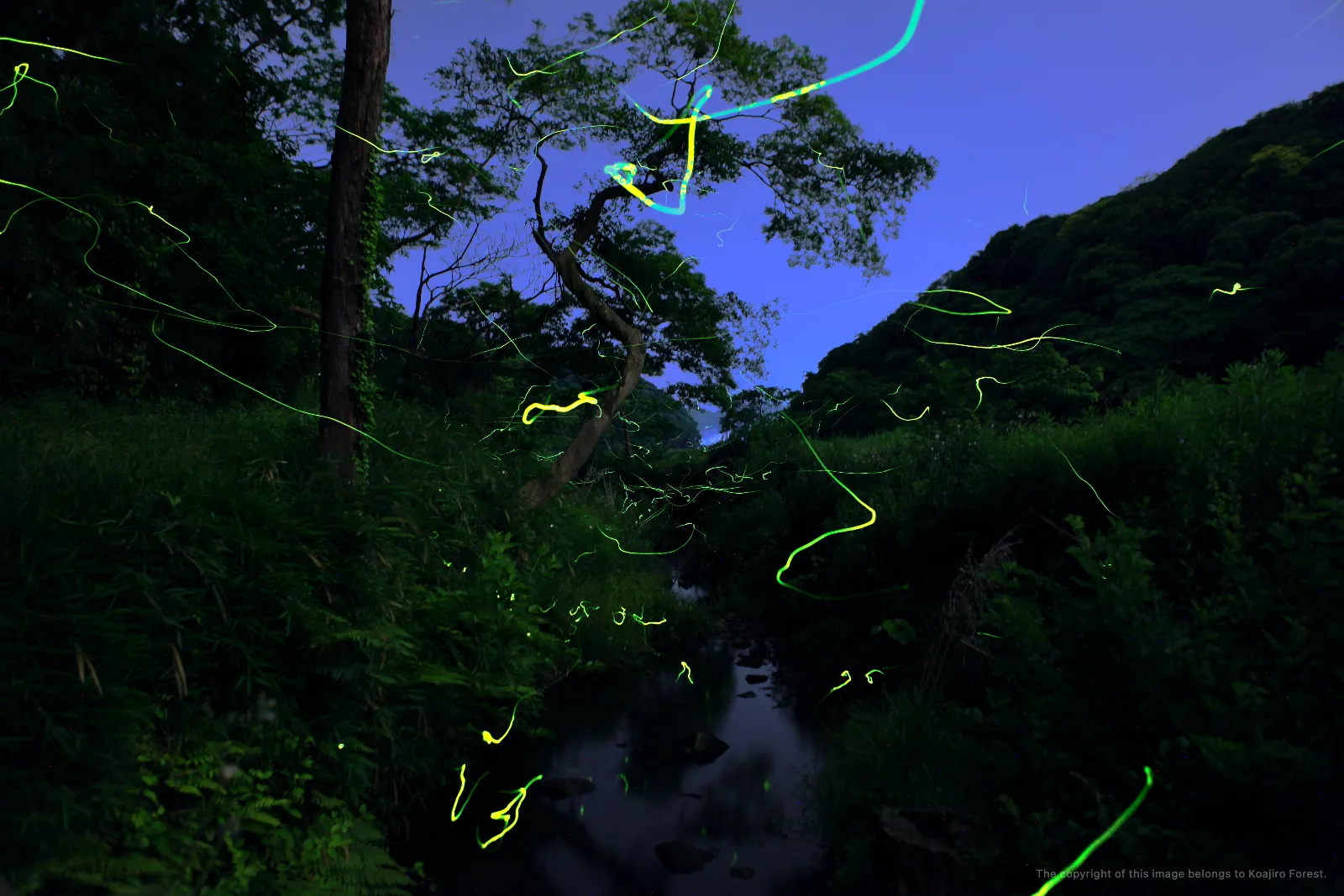
Koajiro Forest, as the rainy season draws near, a light unlike any other season comes to life. The sun sinks below the horizon, and the forest is slowly wrapped in darkness. Through the moist air, soft, drifting glimmers begin to appear — one by one, floating gently onward.
Close your eyes and imagine it. Along the water's edge where the headwaters of the Ura River flow, a yellow-green light moves slowly through the grass, pulsing on and off as though breathing.
The bearer of that light is the Genji firefly — one of the largest fireflies in Japan. Their glow is no mere ornament. It is the only word they have to carry life forward. The males flash as they fly; the females answer from the shelter of the grasses below. When a male catches sight of a female's response, he descends into the undergrowth to find her. For creatures with no voice, the rhythm of light is the only signal by which they can find one another.
Once the Genji firefly season has gently settled, the Heike firefly appears. Slightly smaller, its light softer, its tempo of flickering different. Within the same forest, two species of firefly exchange their light — each in a different place, each at a different moment. This is testimony that the
watershed holds, all at once, clean water, true darkness, and moist earth.
The larvae of the Genji firefly feed on a freshwater snail called the kawanina, which lives only in clear streams. And so, when fireflies dance through the air, it means the water has been carefully protected across a long span of time. Behind each single point of light, the cycles of life stretching back many years lie quietly hidden.
In the few brief nights that fireflies shine, you too are here, breathing. Their fleeting lives and your day today are gently overlapping — together, in the same early summer night.
Season: Early summer (around the rainy season)
Main subjects: Genji firefly (among Japan's largest; larvae prey on kawanina snails), Heike firefly (smaller; appears later in the season)
Highlight: Along the waterside leading to the headwaters of the Ura River — light that pulses on and off as though breathing
Conditions for habitat: A healthy
watershed where clean water, true darkness, and moist earth all come together
Observation etiquette: To protect the habitat, please avoid bright lights and loud sounds
Location: Koajiro, Misaki-cho, Miura City, Kanagawa Prefecture
Map:
Koajiro Forest Map
Official Site:
Koajiro Forest (Kanagawa Prefecture)
Supervising editor: Yuji Kishi (Professor Emeritus, Keio University)
Photography: Hiroichi Yanase (Professor, Institute of Science Tokyo)
Producer:
Eisuke Tachikawa (Representative of
NOSIGNER / Project Professor, Keio University)
Published by:
NOSIGNER / NPO Koajiro Outdoor Activity Coordination Council