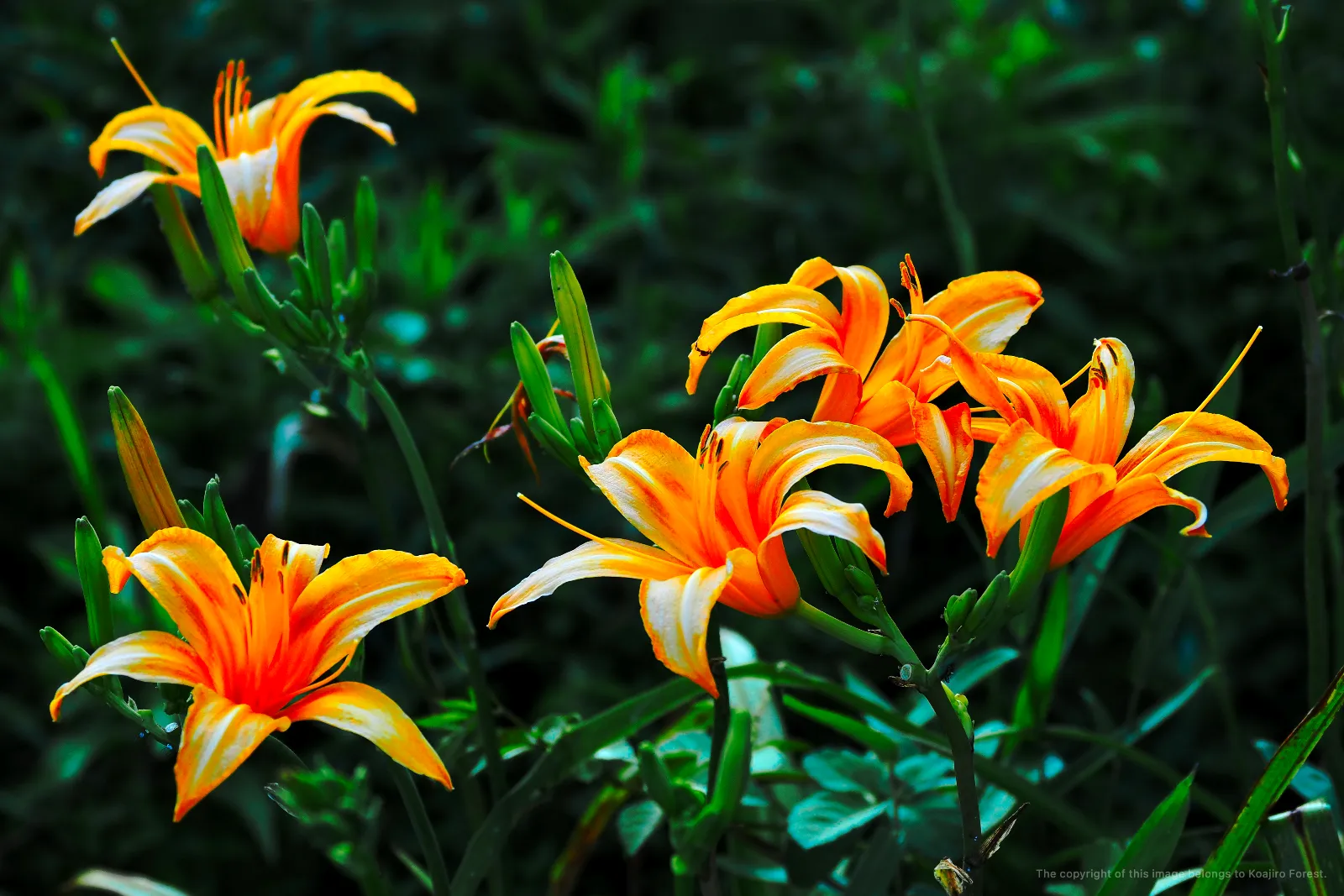
From mid-July through the end of September, the
wetlands near the estuary of Koajiro burst into a world of magnificent orange blossoms. The flowers bear a close resemblance to lilies, yet what blooms here in such glorious abundance is the hamakanzo — a species of kisuge, and a coastal relative of the nikko-kisuge, that beloved flower celebrated for its role in painting the summer landscape of Oze-ga-hara. This native plant reaches its peak bloom in mid-August, at the very height of the year's heat, and the vast colony of hamakanzo in full flower is nothing less than a breathtaking emblem of Koajiro's midsummer wetland world.
To the west of the
tidal flat, the ria inlet of Koajiro Bay stretches roughly 1.5 kilometers inland before opening out into Sagami Bay. At the tip of the southern headland guarding that opening, there once stood Arai Castle — the stronghold of the Miura clan. In the full heat of summer in 1513, the castle was overwhelmed by a furious assault from the rival Go-Hojo clan, and the Miura were annihilated. The ruins of that castle, together with the place name Aburatsubo, have become a site of remembrance and a landmark of the Miura peninsula, kept as a tribute to the tragic fate of the clan. By the modern calendar, the day the castle fell was the nineteenth of August. And so the hamakanzo, blooming year after year in full splendor along the wetland shores of Koajiro at precisely that time, carries with it something strangely profound — a flower whose season, unknowing, marks the anniversary of a vanished world.
Featured plant: Hamakanzo (a species of kisuge / a coastal native relative of the nikko-kisuge)
Season: Mid-July through September (peak bloom in mid-August)
Highlight: A sweeping orange colony filling the
wetlands near the estuary
Nearby: The ruins of Arai Castle of the Miura clan and Aburatsubo, on the headland beyond Koajiro Bay (the castle fell around August 19th)
Location: Koajiro, Misaki-cho, Miura City, Kanagawa Prefecture
Map:
Koajiro Forest Map
Official Site:
Koajiro Forest (Kanagawa Prefecture)
Supervising editor: Yuji Kishi (Professor Emeritus, Keio University)
Photography: Hiroichi Yanase (Professor, Institute of Science Tokyo)
Producer:
Eisuke Tachikawa (Representative of
NOSIGNER / Project Professor, Keio University)
Published by:
NOSIGNER / NPO Koajiro Outdoor Activity Coordination Council