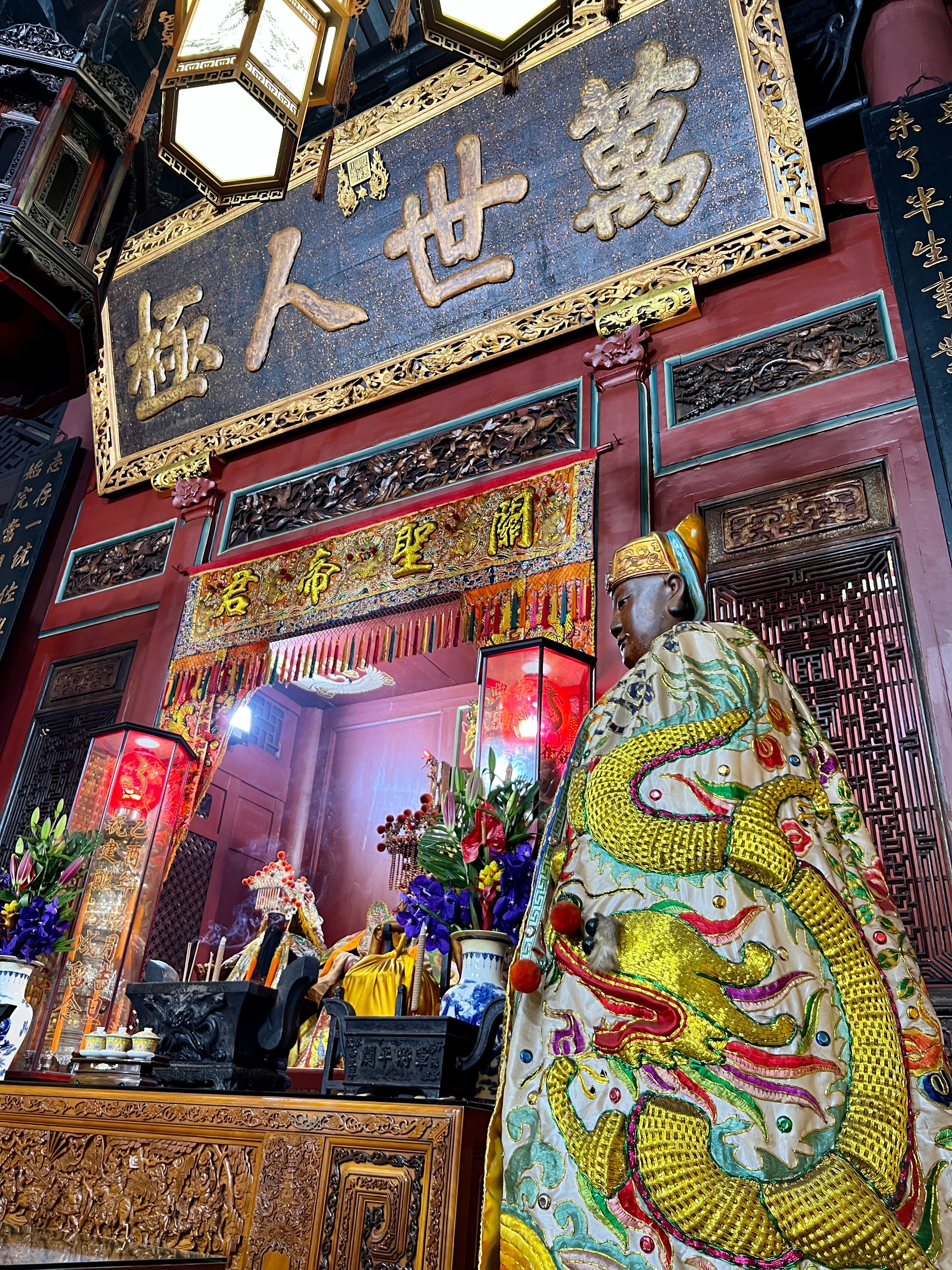
The people of this city have long chosen which temple to visit according to the nature of their wish. First, try walking along the outside of the Sacred Rites…
Multilingual AI audio guide exhibit on WOUDiO (PWA). WOUDiO pioneered the world’s first audio guide platform with built-in donation: listeners can support the cultural venue without leaving the listening experience. The text below is the localized description, details, and narration script for this audio guide stop.
The people of this city have long chosen which temple to visit according to the nature of their wish.
First, try walking along the outside of the Sacred Rites Wumiao, the Temple of Confucius' Martial Counterpart, Guan Yu. A long wall stretches unbroken along the street, following its every turn. Look up, and you'll notice the roofline rising in five distinct tiers. This is architecture meant to be seen from without, not experienced from within.
Enshrined here is Guan Yu, a general from the age of the Three Kingdoms. Merchants did not deify him for his strength, but because he was a man who never broke his word — a god born of an era when contracts turned not on written characters, but on trust. The name "Sacred Rites" (Sidian) marks this as a temple once officially sanctioned by the state itself.
A short walk away stands the Altar of Heaven, Tiantan.
This is a place where Heaven itself is worshipped — a rite that, by rights, only an emperor was permitted to perform. And so this altar also stands as a remnant of the era when the Zheng regime claimed this land as a sovereign state.
Step inside, and look at the plaque hanging directly overhead. A single character, "One," stands alone, surrounded by a dense crowd of smaller characters packed tightly around it. It is said to mean that Heaven sees every thought a person holds, down to the very last one.
For matters of business, go to the Wumiao. For a wish that must be granted no matter what, go to the Tiantan. For a safe crossing of the sea, go to Mazu.
Tainan is not filled with so many temples because its people are especially devout — but because they had, and have, so many different needs.