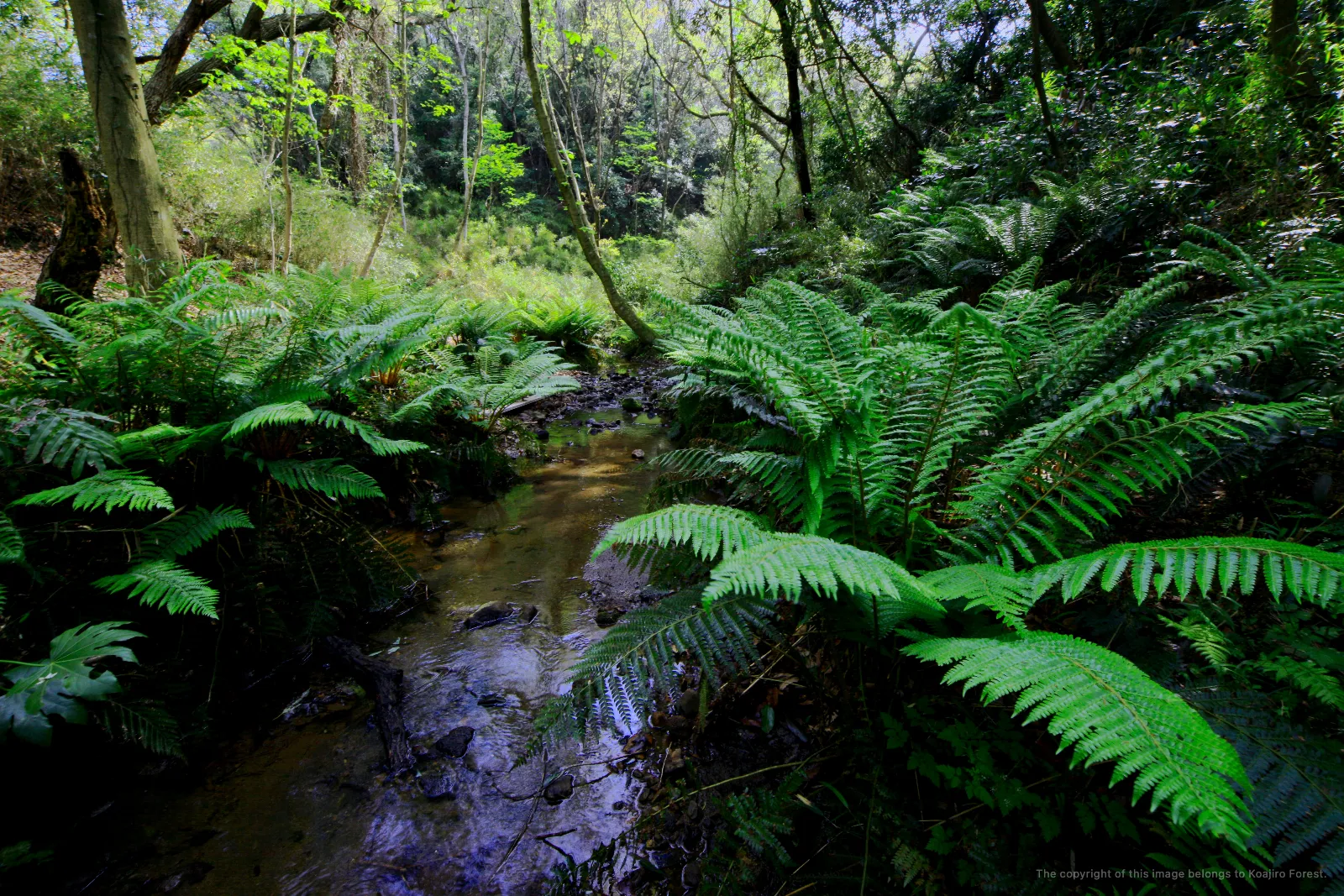
Beyond the quietude of the headwaters, there is a place where the air shifts imperceptibly. It grows cool and slightly damp, and a fresh, green fragrance fills your lungs — this is the stretch of the headwater stream known as the Fern Valley.
Close your eyes for a moment, and imagine it: fronds rising to the height of a person's waist, layer upon layer of them, filling the dim valley with a soft, enveloping green. Each frond is divided into delicate, feather-like segments, and when light finds them, they become almost translucent. With every breath of wind, those feathered leaves sway slowly, and the whole valley seems to breathe in quiet unison.
Ferns do not flower. They carry life forward not through seeds but through tiny spores formed on the undersides of their leaves — a method that long predates the appearance of flowering plants on this earth. More than three hundred million years ago, before even the dinosaurs had come into being, the land was clothed in ferns and their kin. The green that spreads before you now is a living remnant of that ancient landscape, preserved here into the present day.
When you pause to consider it, is there not something wondrous in this? The very air you are breathing at this moment traces a part of its oxygen back to ancient ferns like these, which spent hundreds of millions of years shaping the atmosphere. Your breath and the world of ferns in this valley are connected across an immeasurable span of time — truly and unmistakably connected.
The Fern Valley of Koajiro Forest is sustained by two quiet sources of water: the banks along the headwater stream, where periodic flooding nourishes the ground, and the gently moistened slopes beneath the forest, where water seeps down through bedrock and drips softly onto the hillside. The water wrung from the headwater forest creates, for these ancient plants, precisely the cradle they have always needed.
Long after you have left this place, the green that fills this valley will remain — unchanged in its stillness, unhurried in its purpose — quietly scattering spores in the manner inherited from a distant past, and passing the work of life on to the next generation, as it has always done.
Area: Headwater Area (headwaters of the Ura River) / Fern Valley
Highlights: Dense fern colonies rising to waist height; reproduction by spores on the undersides of fronds; a landscape evoking primeval vegetation
Botanical characteristics: An ancient lineage that reproduces by spores rather than flowers, with origins some 300 million years ago
Environment: Gently moistened slope fed by seepage from the headwater spring
Related: The slope inhabited by
red-clawed crabs emerging from hibernation /
Koajiro Forest
Location: Koajiro, Misaki-cho, Miura City, Kanagawa Prefecture
Map:
Koajiro Forest Map
Official Site:
Koajiro Forest (Kanagawa Prefecture)
Supervising editor: Yuji Kishi (Professor Emeritus, Keio University)
Photography: Hiroichi Yanase (Professor, Institute of Science Tokyo)
Producer:
Eisuke Tachikawa (Representative of
NOSIGNER / Project Professor, Keio University)
Published by:
NOSIGNER / NPO Koajiro Outdoor Activity Coordination Council