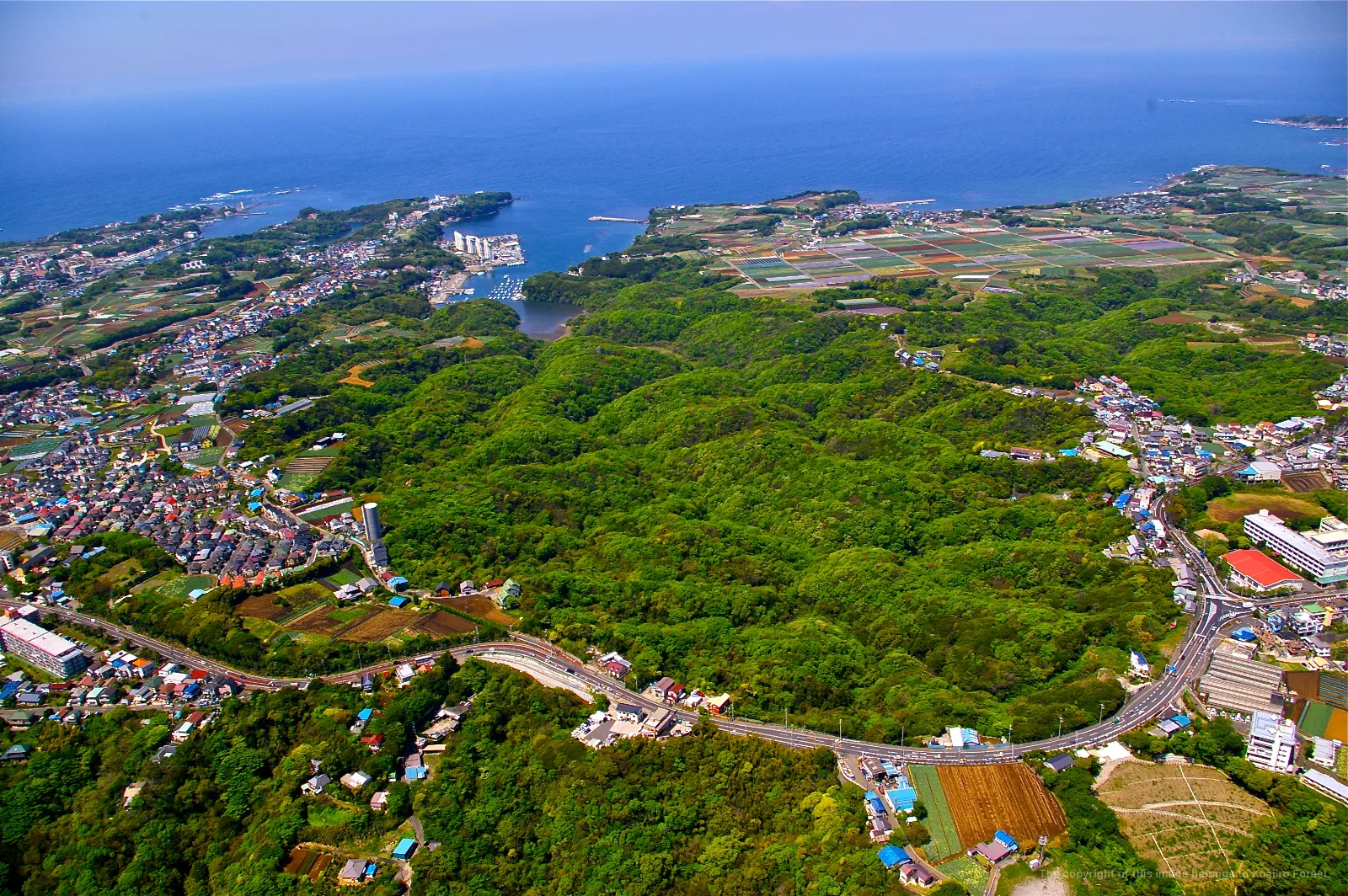
Take a moment to retrace in your mind the path you have walked. The stillness of the
headwaters where water is born, the fern-draped valleys, the
alder forest of the wetlands, and the midstream where the river widens and flows on. At last, the water reaches the
[tidal flat](https://woud.io/koajiro/ja/koajiro_11), where it merges with the sea. This unbroken sequence of connections has a shape. Seen from above, the
forest of Koajiro looks just like a single leaf. The leaf's outer edge corresponds to the watershed divide — the ridge that separates one drainage basin from another. From various points along that edge, valleys extend like slender veins, carrying streams that join and merge into the main current before flowing out to the ocean. We call this leaf-shaped land — which gathers rainwater into every tributary and every main channel of a whole river system — a
watershed.
Designer
Eisuke Tachikawa, who encountered this forest while developing ADAPTMENT, a framework for climate-adaptive urban design, was deeply moved by the work of Mr. Kishi and the Koajiro Outdoor Activities Coordination Council. So that this method of ecosystem conservation through watershed thinking might be understood around the world, he gave it a name: Leaf Forest.
Why does it matter so much to protect an entire watershed — an expanse of green shaped like a leaf? Because the watershed is the seamless unit that sustains the diversity of life around it. The roughly
more than 2,000 species of living things that exist within this ecosystem cannot survive in any single place alone.
The green that the forest embodies need only be protected in the shape of a watershed — the shape of a leaf. In that way, the creatures of the surrounding land have somewhere to flee. Perhaps Noah's Ark was never a ship at all, but a leaf-shaped forest — an ecosystem itself. And Koajiro is where that movement began. When you think of it that way, does the meaning of standing in this forest not settle quietly into your heart?
It was while contemplating ideas for this forest's conservation that Tachikawa invented
WOUDiO, this audio guide that gathers donations for nature and culture. WOUD is the Danish word for forest.
The conservation of Koajiro trusted in the very mechanism by which water flows, the very pathway through which life circulates, and in doing so preserved an entire leaf-shaped ecosystem. Just as a sip of water seeps through your body, so too does this forest circulate an unbroken thread of water from its headwaters to the sea. Like water tracing the veins of a leaf, life flows ceaselessly, connects, and returns again. As part of that cycle, watersheds exist in every corner of the world.
It is a familiar feeling — and a hope for the future. For many places on this Earth where you are listening, were once, like Koajiro, a Leaf Forest.
Theme: Ecosystem conservation through watershed thinking — "Leaf Forest"
Origin: Named by
Eisuke Tachikawa, who encountered this forest while developing ADAPTMENT / WOUD is Danish for "forest"
Keywords: Watershed = leaf-shaped ecosystem / More than approx. 2,000 species of life
Related: Donation-based audio guide
WOUDiO ·
History of Koajiro's conservation
Location: Koajiro, Misaki-cho, Miura City, Kanagawa Prefecture
Map:
Koajiro Forest Map
Official Site:
Koajiro Forest (Kanagawa Prefecture)
Supervising editor: Yuji Kishi (Professor Emeritus, Keio University)
Photography: Hiroichi Yanase (Professor, Institute of Science Tokyo)
Producer:
Eisuke Tachikawa (Representative of
NOSIGNER / Project Professor, Keio University)
Published by:
NOSIGNER / NPO Koajiro Outdoor Activity Coordination Council