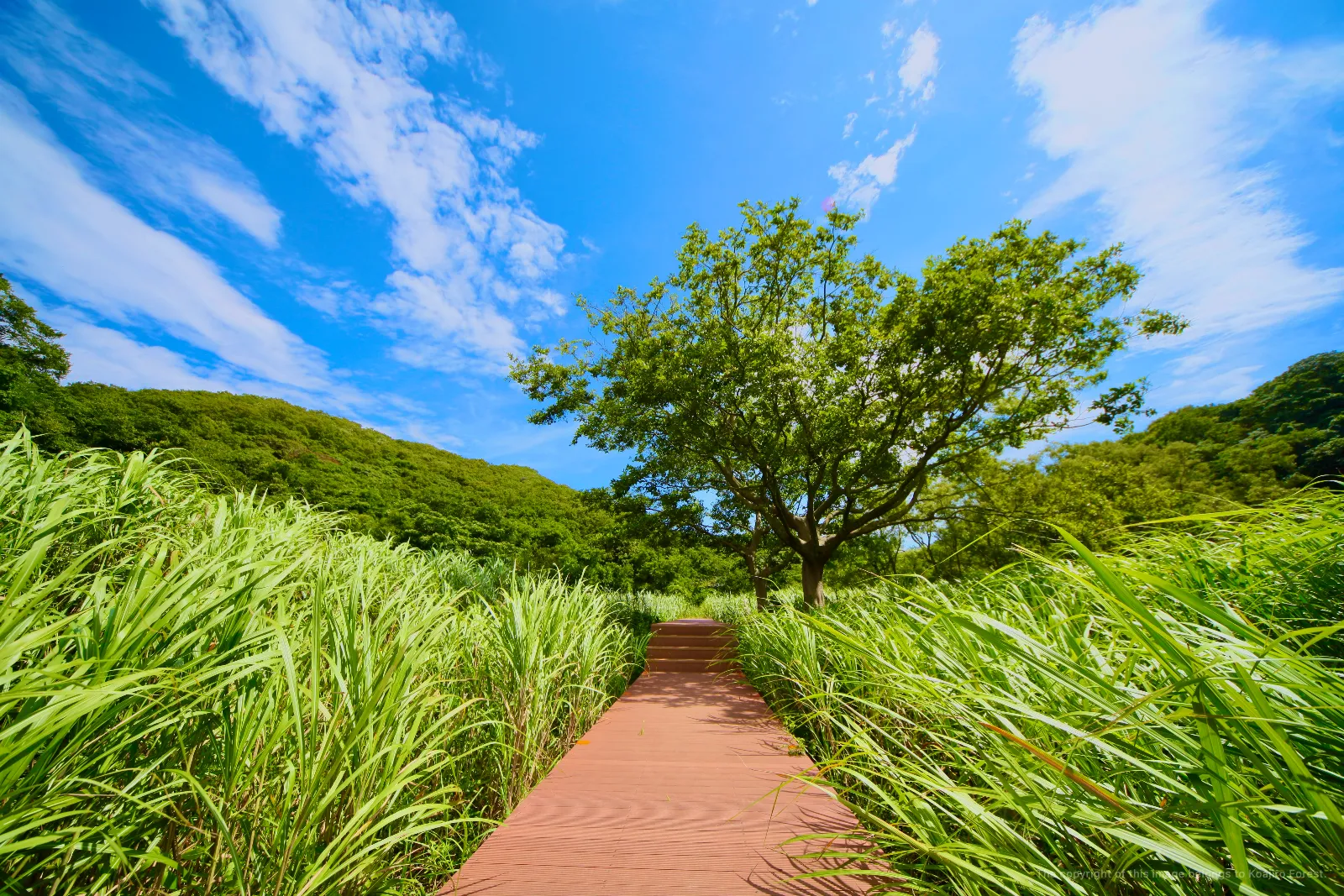
A single path stretches out in quiet order. As we make our way through
Koajiro Forest, we walk along a beautifully crafted boardwalk. But why, one might wonder, do we not simply walk upon the muddy earth below? The answer to that question holds a gentle wisdom — a wisdom devoted to the protection of this forest.
The ground of a wetland is far softer than it appears, saturated with water. Beneath our feet lies a world of mud rich with moisture and nutrients, tiny plants just beginning to push through the soil, and countless living creatures making their homes within the earth. If human feet were to press directly upon that ground, the soft soil would compact, the pathways water travels would be sealed shut, and the fragile lives quietly reaching down their roots might be severed — without anyone ever knowing.
The boardwalk was born from the need to disturb that delicate ground as little as possible. By raising the path slightly above the earth, visitors can walk without compacting the soil beneath, allowing water to continue its slow and unhurried passage. From the headwaters of the Ura River, through the wetlands, and on to the sea — the boardwalk is, in a sense, a promise made between the forest and its people: that the living thread connecting these waters shall not be broken.
At the
Koajiro Wetlands, however, the story grows a little more intricate. The wetlands here are not the preserved remnants of some ancient, primordial marsh. Until the 1960s, the low-lying land throughout the Koajiro valley was entirely given over to terraced rice paddies. As the 1970s arrived, those paddies fell silent one by one, and the land was designated for urban development in anticipation of large-scale construction. It was not until 2005 that the conservation of the Koajiro valley was secured under the Act on Conservation of Suburban Green Space, a law administered by the Ministry of Land, Infrastructure, Transport and Tourism. By that year — already four decades after rice cultivation had ceased — the valley floor had transformed entirely into a dry world of bamboo grass and scrub. Dragonflies and
fireflies alike had begun to disappear.
With conservation finally assured, the work began to transform this dried and altered valley into a vast wetland — something to take the place of the old rice paddies. The effort was led by a citizens' group that would later be incorporated into the NPO Koajiro Field Activities Coordination Council. Under the guidance of ecological experts, the organization felled the bamboo grass and scrubland that had spread across the entire valley, and carved a network of new channels along the valley floor to prevent the bamboo grass from reclaiming the land. At the heart of this system ran an artificial waterway created along the central axis of the valley — and the long, protective "lid" built to cover and shield that channel turns out to be none other than the boardwalk itself, which accounts for a considerable portion of the walking trail.
As you walk the boardwalk at Koajiro, pause from time to time and listen to the sounds beneath your feet. In many places, you will hear the unmistakable sound of flowing water. In some spots, you may even catch a clear glimpse of the channel itself running beneath the planks ahead of you. The waterway protected by the boardwalk is designed to branch and diverge — left and right — at various points along its course. Those who walk the boardwalk after heavy rain may witness the entire wetland transformed into something resembling a lake, as water spreads out from the channels in every direction. Koajiro is, in this sense, a grand created ecosystem — one that harnesses the rainwater gathered by its
watershed topography through the knowledge and theory of ecology, shaped by human hands into something living and whole.
Theme: How the boardwalk protects the wetland
Key point: By raising the path above the ground, the boardwalk prevents soil compaction and avoids disrupting the flow of water and life
A second role: The boardwalk also serves as a protective "lid" over the artificial waterway created along the center of the valley
History: Terraced rice paddies until the 1960s → abandonment → conservation secured in 2005, followed by the creation of new waterways and a constructed ecosystem
Related:
History of Koajiro Conservation ·
Watershed
Location: Koajiro, Misaki-cho, Miura City, Kanagawa Prefecture
Map:
Koajiro Forest Map
Official Site:
Koajiro Forest (Kanagawa Prefecture)
Supervising editor: Yuji Kishi (Professor Emeritus, Keio University)
Photography: Hiroichi Yanase (Professor, Institute of Science Tokyo)
Producer:
Eisuke Tachikawa (Representative of
NOSIGNER / Project Professor, Keio University)
Published by:
NOSIGNER / NPO Koajiro Outdoor Activity Coordination Council