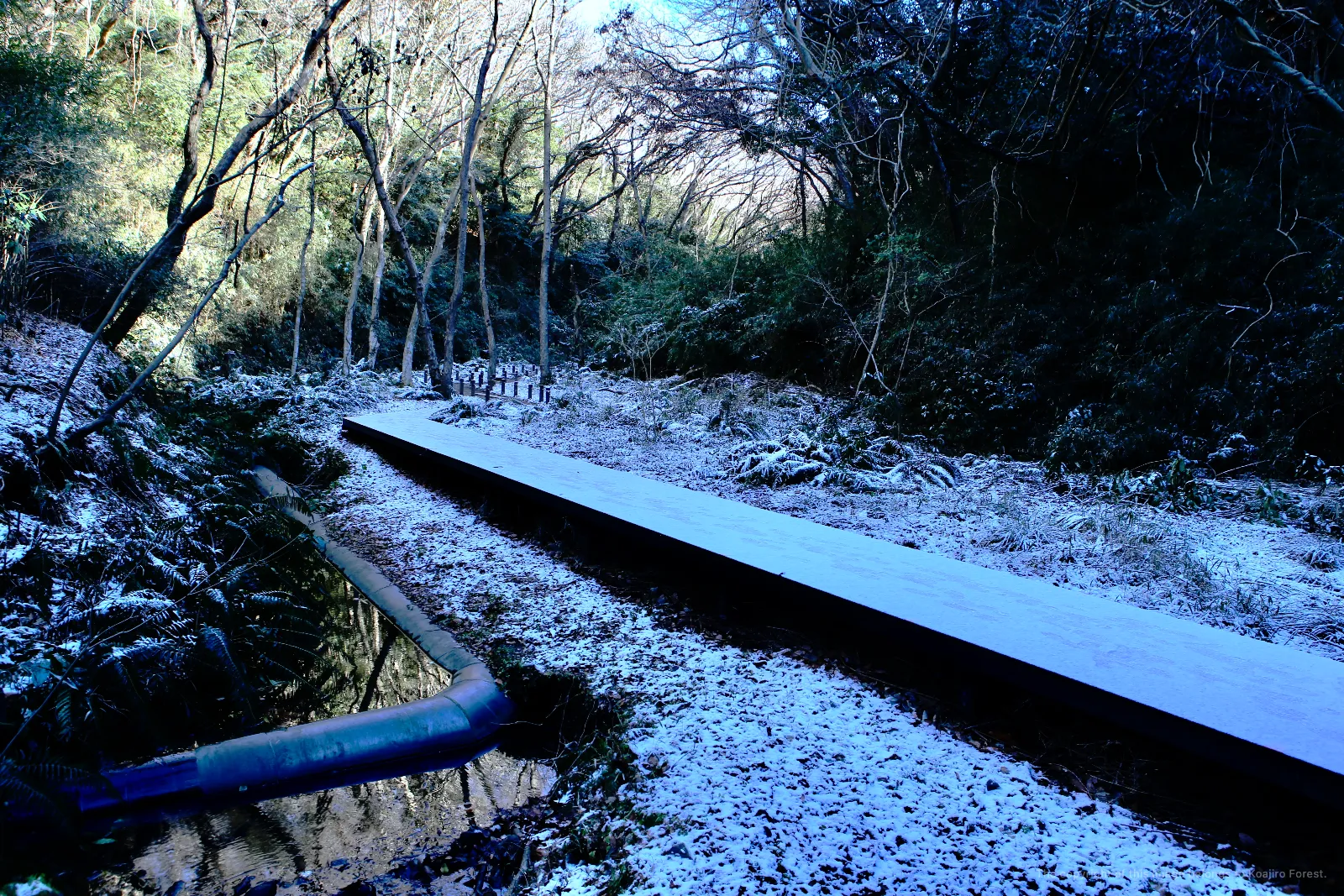
Winter is the season when the air in
Koajiro Forest runs clearest of all. Cold, dry winds move through the trees that have shed their leaves. The green veil that draped the forest through summer has lifted, and the bare bones of the woodland stand revealed — and yet, within that stillness, the signs of life grow only more vivid.
Listen carefully. Clear, bright calls travel from branch to bare branch overhead. The voices belong to small birds who have journeyed here from distant northern lands —
migratory visitors such as the Black-faced Bunting, Dusky Thrush, Pale Thrush, and, if you are fortunate, the Grey Bunting. Out on Koajiro Bay, where the Ura River meets the sea, flocks of Mallards have been spotted, and sometimes even Mandarin Ducks drift across the water.
Through the open canopy of the leafless woodland, lively, chattering flocks of small birds pass like a wave. Great Tits, Varied Tits, and Long-tailed Tits move together, and occasionally joining them is the Japanese Pygmy Woodpecker — the smallest woodpecker found in Japan. Winter in the woodland is also a season of heightened danger, as hawks and raptors become more active hunters. These mixed flocks are understood to be a form of cooperation among small birds, a collective strategy for watching over one another against the threat of birds of prey.
Season: Winter (the time of year when the air is at its clearest)
Winter migratory birds: Black-faced Bunting, Dusky Thrush, Pale Thrush, Grey Bunting / Mallard and Mandarin Duck on Koajiro Bay
Mixed flocks: Great Tit, Varied Tit, Long-tailed Tit, Japanese Pygmy Woodpecker (cooperative behavior for protection against raptors)
Highlight: In the leafless woodland, the presence of life becomes all the more striking
Related:
The World of Wild Birds in spring and early summer
Location: Koajiro, Misaki-cho, Miura City, Kanagawa Prefecture
Map:
Koajiro Forest Map
Official Site:
Koajiro Forest (Kanagawa Prefecture)
Supervising editor: Yuji Kishi (Professor Emeritus, Keio University)
Photography: Hiroichi Yanase (Professor, Institute of Science Tokyo)
Producer:
Eisuke Tachikawa (Representative of
NOSIGNER / Project Professor, Keio University)
Published by:
NOSIGNER / NPO Koajiro Outdoor Activity Coordination Council