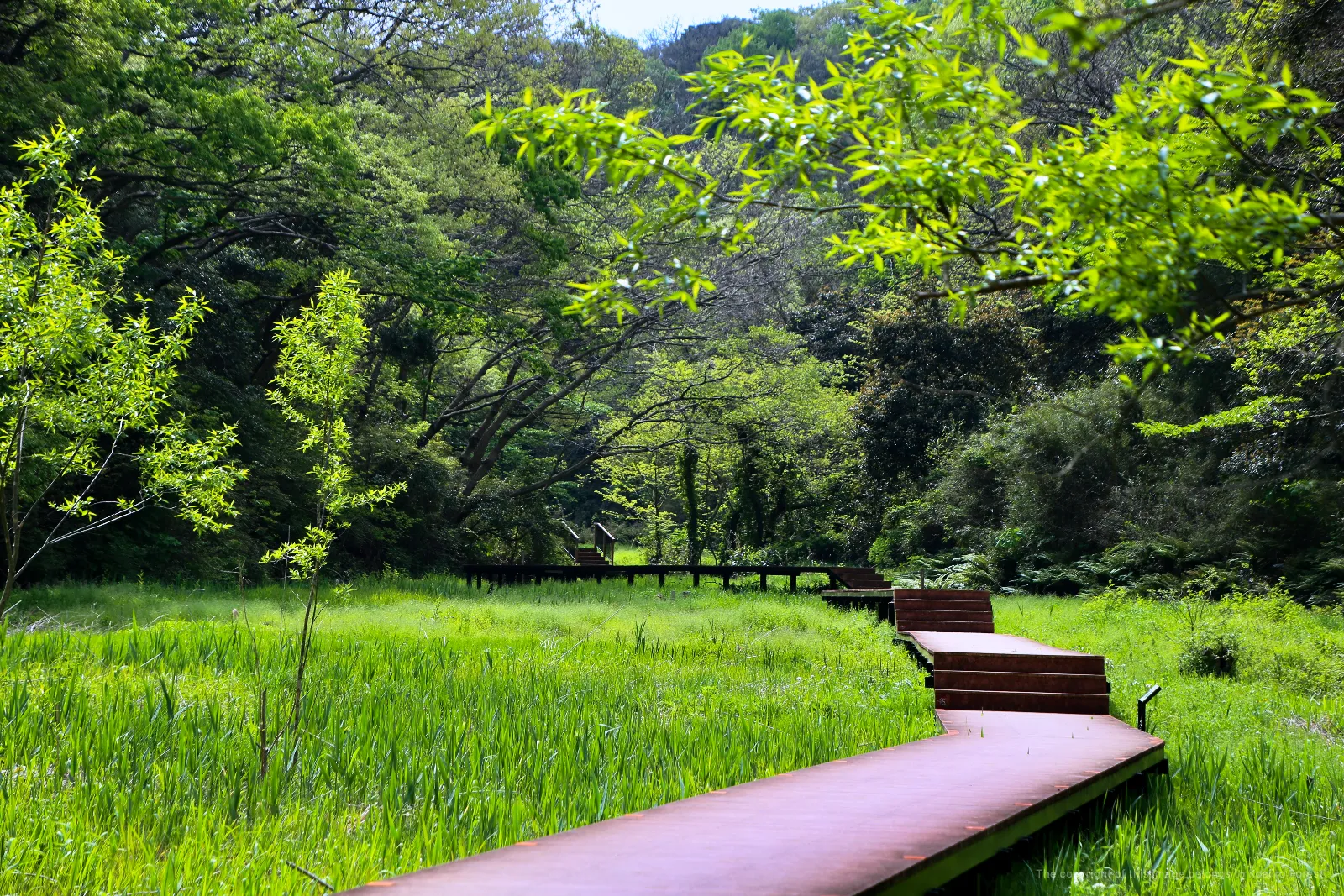
Beyond the alder forest, large trees with sprawling, intricate branches begin to catch the eye throughout the wetland — so different in form from the alders…
Multilingual AI audio guide exhibit on WOUDiO (PWA). WOUDiO pioneered the world’s first audio guide platform with built-in donation: listeners can support the cultural venue without leaving the listening experience. The text below is the localized description, details, and narration script for this audio guide stop.
Beyond the
alder forest, large trees with sprawling, intricate branches begin to catch the eye throughout the
wetland — so different in form from the alders that grow straight toward the sky. These are Jaya willows, wild willows known by the name *Jaya-yanagi*.
These willows take root in marshland even murkier and deeper than that favored by the alders, and there they pass their lineage from one generation to the next. Yet they do not spread by releasing seeds. It is said that all specimens of this species found in Japan are female, and as such, they are unable to produce seeds at all. So how, then, do they reproduce?
When a strong wind stirs the branches of a Jaya willow, they snap away with surprising ease and go spinning through the air like bamboo dragonflies. If a fallen branch lands just right and its tip catches in the soil, it can take root from that very point and grow into a towering tree. And it is not only the branches — when an entire great tree is toppled by the wind, young shoots sprout from the fallen trunk itself, nurturing the next generation into being. This remarkable way of propagating is known as *tōboku kōshin*, or fallen-log regeneration. Throughout the wetlands of Koajiro, you may well come upon the sight of young trees rising from the ruins of fallen ones.
Featured subject: Jaya willow (*Jaya-yanagi*) — a large willow that grows in marshland even deeper and muddier than that of the alders
Highlights: Large trees with complex, spreading branches standing throughout the
wetland beyond the
alder forest
Reproduction: Only female specimens are found in Japan, producing no seeds / spreads via wind-scattered broken branches and 'fallen-log regeneration'
Observation: Young trees growing from fallen logs can be witnessed at various spots throughout the wetland
Location: Koajiro, Misaki-cho, Miura City, Kanagawa Prefecture
Map:
Koajiro Forest Map
Official Site:
Koajiro Forest (Kanagawa Prefecture)
Supervising editor: Yuji Kishi (Professor Emeritus, Keio University)
Photography: Hiroichi Yanase (Professor, Institute of Science Tokyo)
Producer:
Eisuke Tachikawa (Representative of
NOSIGNER / Project Professor, Keio University)
Published by:
NOSIGNER / NPO Koajiro Outdoor Activity Coordination Council
Venue-official content of Koajiro Forest. Supervised by: 小網代の森.