The long journey of the Urano River, born in the headwaters of the forest, reaches its end where it meets a great tributary near the river's mouth — and below that confluence, a magnificent tidal flat unfolds. This is where the freshwater born in the forest meets, in quiet communion, the tides that rise from the sea. Twice each day, the tide floods in and withdraws. And with every turning, the salinity of these waters shifts from moment to moment. Neither sea nor river — this is a world in between, forever wavering. It is precisely this ambiguity, this beautiful uncertainty, that nurtures an almost unbelievable abundance of life.
More than one hundred species classified as threatened with extinction across Japan have been recorded in the tidal flat of Koajiro. It is a small flat, covering just three hectares, yet the density of rare species per unit area is, when viewed on a national scale, almost certainly without equal.
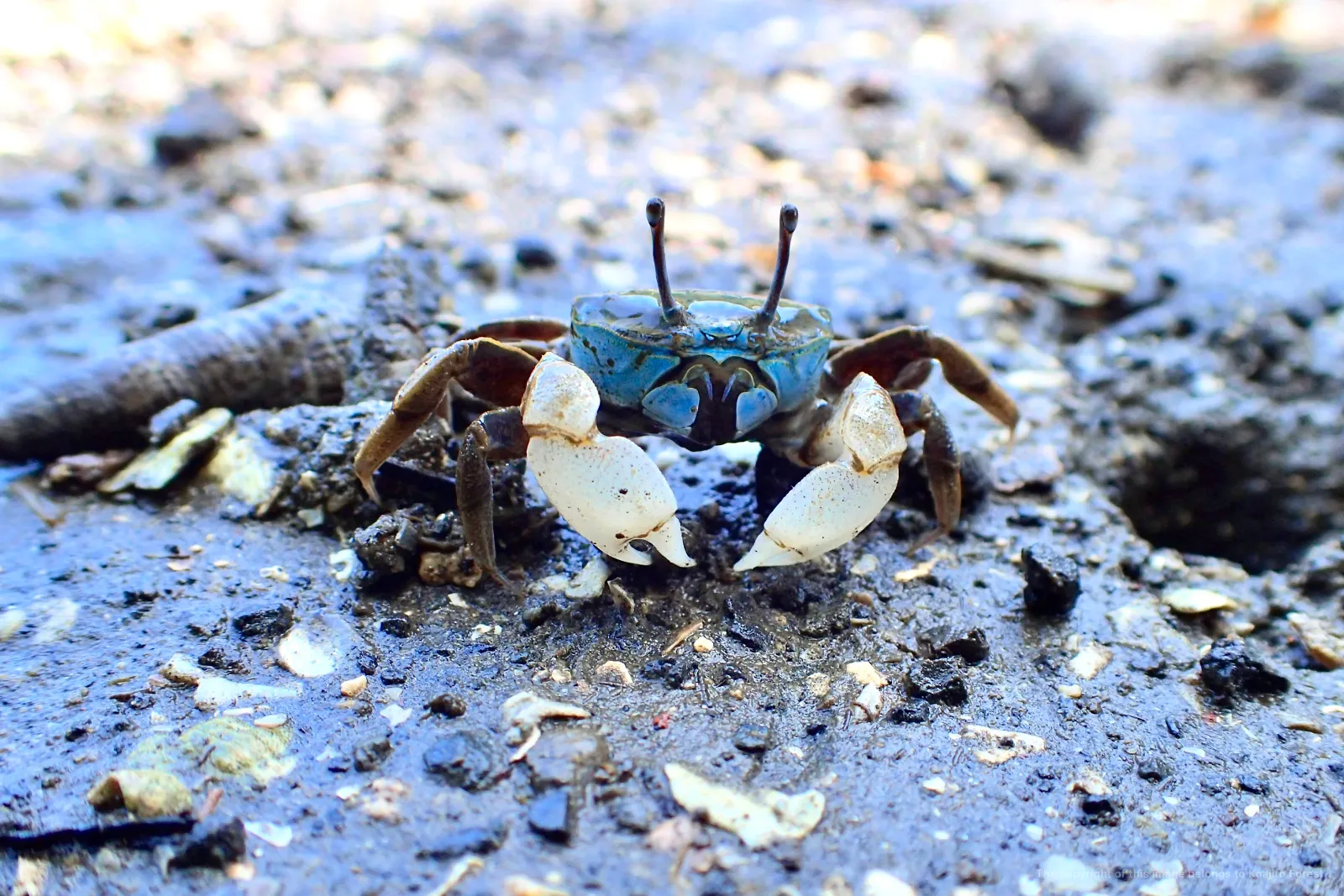
The undisputed favourite of Koajiro's tidal flat is, perhaps, the dancing Soldier Crab. From spring through summer, when the tide withdraws, countless small holes appear across the surface of the exposed mud. Beside each hole, you will find a tiny crab — barely a centimetre across — tirelessly raising and lowering its claws in an unmistakable dance. Only the males dance. They are performing a courtship display, calling out to females who wait in the burrows below their feet. On a fine day, the Soldier Crabs dance without pause for the entire time the tide is out, as though they cannot bear to spare a single moment for feeding.
Sharing the same mudflats where the Soldier Crabs perform, though at a somewhat more leisurely pace, are the Sand-bubbler Crabs, whose movements echo the dance of their neighbours. If you look further out toward the centre of the flat, you may catch sight of Naticid Ghost Crabs and Ghost Crabs moving slowly near the channels of the tidal creeks, waving their large claws in long, unhurried arcs.
Sadly, most of the crabs other than the Soldier Crab have suffered a severe decline in numbers. When the great tsunami of 2011 struck, the withdrawing surge tore away vast quantities of mud from the flat, and the world of the crabs was thrown into violent upheaval. It is the Soldier Crabs who have at last begun a spirited recovery. The full return of the crab community that once thrived here may still be ten years away — perhaps twenty — but in the exuberant dancing of the Soldier Crabs, there is a promise that that day will surely come.
At the edge of the tidal flat in midsummer, another story unfolds: it is here that the mother crabs of the Red-clawed Crab — a creature of the forest — come to release their zoea larvae into the sea.
The females of the Red-clawed Crab, who make their lives deep in the forest, keep to a precise schedule for delivering their sea-bound young to the water. It is the several days surrounding the full moon and the new moon, from late June through late September. When a mother crab is ready to release her young, she gathers with the others at the edge of the tidal flat, and in the half-hour or so after sunset, they enter the sea together, releasing their zoea larvae into the waves. The larvae drift and grow through the warm waters of Koajiro Bay — a bay more than a kilometre deep — for an entire month. There they metamorphose into the stage called megalopa, and then return once more to the edge of the flat, where they transform again into juvenile crabs and make their way home to the forest.
Location: Tidal flat at the mouth of the Urano River (approx. 3 ha; brackish zone where fresh and salt water mix)
Characteristics: Salinity fluctuates with two tidal cycles per day / More than 100 species recorded at threatened-with-extinction levels
Key species: Soldier Crab (courtship dance), Sand-bubbler Crab, Naticid Ghost Crab, Ghost Crab
Related: In midsummer, mother
Red-clawed Crabs release their zoea larvae into the sea here
Challenges: The 2011 tsunami drastically reduced crab populations; recovery is currently underway
Location: Koajiro, Misaki-machi, Miura City, Kanagawa Prefecture
Map:
Koajiro Forest Map
Official Site:
Koajiro Forest (Kanagawa Prefecture)
Supervising editor: Yuji Kishi (Professor Emeritus, Keio University)
Photography: Hiroichi Yanase (Professor, Institute of Science Tokyo)
Producer:
Eisuke Tachikawa (Representative of
NOSIGNER / Project Professor, Keio University)
Published by:
NOSIGNER / NPO Koajiro Outdoor Activity Coordination Council